The Cumberland settlements in the 1780’s were no place for the timid. Killings were an almost daily fact of life, but the violence was almost always from the outside aimed inward. The ongoing war between the Chickasaw, Cherokee, Creek and others against the European interlopers camping on their ancestral hunting ground claimed hundreds of lives, and given the external threat, violent crime between the settlers was very rare.
One or the first (if not the first) known murder in Nashville, involved an old campaigner. Little is known about Solomon White other than a few brief mentions in various sources. He was one of the “Over the Mountain Men” of Watauga who fought with John Sevier at King’s Mountain in 1780. By 1783 he had migrated to the Cumberland country and had claim on a land grant on Red River in what is now Montgomery County south of Guthrie, Kentucky.
Solomon evidently had a temper. The Records of the Superior Court of North Carolina contain the only known record of his crime, which is laid out in the quaint legal language of the day. On June 13, 1786, “being moved and seduced by the instigation of the Devil,” White took a “cutting pole of the value of six pence,” and used it to hit John Harris over the head with it, killing him instantly. [Incidentally, if anyone knows what a “cutting pole” is exactly, let me know. I’m stumped by that one. Drop me a comment if you know.]
He was indicted for murder, and at his trial in November, 1788 he plead not guilty, and “put himself upon God and his Country.” The proceedings were heard in the first courthouse, an eighteen foot square log house near the old fort on “The Bluffs.” After weighing the evidence the jury found White not guilty of murder, but guilty of manslaughter. Shortly thereafter he was brought before the bar and asked if he had anything to say “why sentence of death should not be passed against him.”
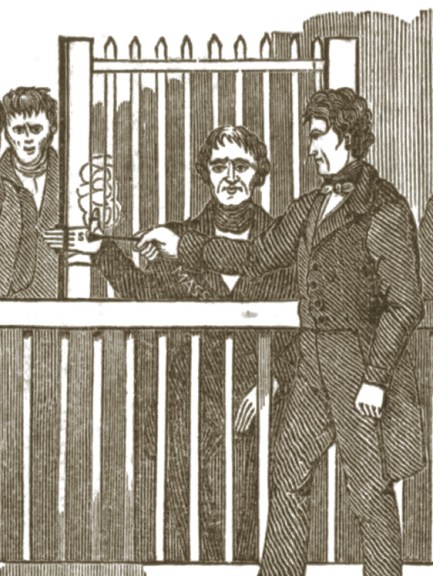
What followed was straight out of English common law, which most of the settlers were familiar with. White pleaded “Benefit of Clergy,” which was granted. Originally, this was a Medieval practice in which the accused proved he could read and write, thereby moving his case from the civil courts into the ecclesiastical courts (in those days, literacy was almost always the realm of the clergy.) In time, however, it came to be used as a “legal fiction,” and a handy way of granting a lesser, but still severe, punishment for a first conviction. If the prisoner was ever brought before the court again, he was also conveniently marked as a repeat offender. In White’s case, he was to be branded on the palm below the thumb with the letter M, signifying manslaughter.
With the exception of the word “State” in the place of “King,” the sentence was carried out exactly according to English judicial procedures: “It is therefore ordered that the said Solomon White be continued at the bar of the Court and there be branded on the brawn of the left thumb with the letter (M) and that the iron be kept thereon until the said Solomon White express the words God Save the State and that the sheriff of Davidson put this sentence in ixecution [sic] immediately in presence of the Court.”
For his sake, one hopes Solomon White was a fast talker.
 nashvillemayhemdotcom