Happy Halloween!

And in keeping with the spirit of the season, here’s some spookiness associated with one of the stories in the book.

At midnight on Feb. 26, 1888 a reporter for the Nashville American dropped by the county jail on Front Street (now 1st Ave.). John R. Grimes, the night turnkey, met him at the door, shaking and in a sweat, and stated, “I’m mighty glad to see you!” And thereby hung a strange tale.

Grimes said he’d been on his nightly rounds, lantern in hand, when he paced down “Murderer’s Row,” where those held for capital crimes were incarcerated. The cells of the row were vacant save one, which was occupied by N.B. Lester, who was sentenced to death for the murder of J.T. Lane at Lebanon. (He was hanged that spring).

Grimes was thinking about Lester and his upcoming execution, when all at once his lantern (which had just been filled and the wick trimmed) went out without explanation, leaving him standing in “total darkness” outside the last cell on the row, which had most recently been occupied by Ben Brown.

Ben was a Civil War veteran who had been convicted of murdering his neighbor Frank Arnold in a gruesome crime that became known as the “Headless Horror.” Brown had spent his final days in that cell, piously reading his bible while the attorneys fought for his life. On Apr. 15, 1887, after his last appeal ran out, he was hanged in the yard of the jail before a small crowd of witnesses.

As Grimes’ eyes adjusted to the darkness, he focused on the door of Brown’s old cell. And then he got the shock of his life. “On my honor as a man,” he told the skeptical reporter, he saw Ben Brown, dressed in his familiar long black coat, his little bible clutched in his hand, just as he’d appeared in life. The ghost stood at the bars, glaring out at Grimes, muttering something that the jailer couldn’t make out, “just as he did the night before he was hung.” Grimes confessed he was frozen in fear, unable to run or shout for help.

Just then he heard the bell ring upstairs announcing the arrival of the reporter, and the spell seemed to break. Grimes ran upstairs to answer it and stammered out his story to a rather puzzled and bemused pressman.

However, there was at least one other witness on his side. An African-American man who was housed in the cell next door to Brown’s during and after the execution later made a surprising statement. He said that he too had seen Ben Brown several times…both before and after he’d hanged.

Presumably, Ben’s ghost was evicted when the jail was torn down the following year. However, if you go strolling along First Avenue today, keep your eyes peeled: that night-owl you see in the long black coat with the black hat on his head and the bible in his hand may not be all that he appears to be at first glance…
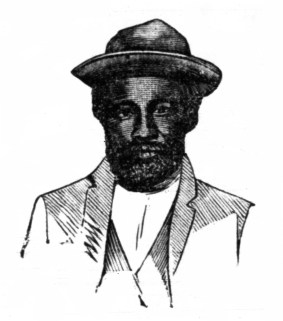
Ben Brown.jpg
Ben Brown, from a photo, ca. 1886


Happy Halloween!

It Coulda Happened to Anyone…

Here’s some more late-breaking news from the fall of 1865, as Nashville was beginning to recover from the late Civil War.

It was a crime-ridden season, and among the shootings and stabbings and black-jackings that happened every night in Smoky Row, came this sensational piece of intelligence that seemed to indicate an attempt at mass-murder:

We learned yesterday that a family of six persons living on Line street, were poisoned by a servant girl who used arsenic instead of leaven in making bread. No deaths ensued, but they were a very sick family from the effects of the deadly poison…” [Daily Dispatch, Sep. 30, 1865.]

There was a brief rumble in the press about the incident, with some speculation about whether it was really an accident, which prompted the following remarkable press release:

“To the Editor of the Nashville Dispatch: In yesterday morning’s Dispatch I find some mistakes. It was not done by a servant, as we do not have any. I made the mistake, using arsenic, instead of leaven, at supper time, in the biscuit, and five of the family partook of them, and were made very sick, but it did not prove fatal to any. We are all doing well. It was Mrs. E.V. Wilson’s family, and the mistake was made by her eldest daughter. Very respectfully, Isabella E. Wilson, Corner of Spruce and Line streets.” [Daily Dispatch, Oct. 1, 1865.]

It’s a bizarre story, made more so by the flippant “what will the neighbors think” rebuttal offered by the family. It begs follow-up questions: What was a tub of raw arsenic doing in the kitchen next to the leavening? Who was the lucky one who didn’t “partake” of the biscuits? Was it the eldest daughter? And did that indicate knowledge of the poison beforehand? Was she ever allowed to cook dinner for the family again?

Alas, many questions and no real answers in this obscure family drama. For the record, the address given would today be the corner of Jo Johnston and 8th Avenue…if there was still such an intersection. Rosa L. Parks Blvd. now passes right over the former site of the residence. Isabella E. Wilson is listed, age 30, on the 1860 census, in the same household as 61-year old Eleanor V. Wilson (evidently “Mrs. E.V. Wilson”) and five members of the John. D. Gower family (probably her son-in-law and grandchildren). The author of the note is evidently the one who made the lethal biscuits, and it probably explains its “no harm done” tone.

Just another day in postwar Nashville. More to come…

The Rest…Of the Story

…With apologies to Paul Harvey.

One of the frustrating things about writing a book is that often you find stuff about the subject only after it goes to press, and too late to insert into the manuscript. A prime example is the following tale, which only surfaced after the writing was done.

Jesse Avritt Bryan was born in 1815 and raised in Clarksville, Montgomery County. His father served in Congress but died when Jesse was only a youngster. He later became a partner with his brothers in a mercantile firm, and was quite popular – if touchy. “he was of a proud and sensitive nature,” one friend later wrote, but one that “could not brook aught of insult.” This sensitive nature got him into serious trouble in the summer of 1838 when he was 22.

Somehow he ran afoul of the starchy Marius Hansbrough, a 37-year old fellow Clarksvillian. Hansbrough was married, and his first and only child – a daughter – had been born earlier that year. He’d also apparently had a few hard knocks to deal with – in 1832 while he was attending a celebration of Washington’s birthday at Shelbyville, Kentucky, a cannon had exploded and his right arm had to be amputated from the resulting damage. In 1836 he had partnered up with G.A. Davie and purchased the Washington Hotel on the public square, the most prominent hotel in Clarksville. It would end up being a house he never left.

clarkpubsquare
The Washington Hotel, on the north side of the Clarksville Public Square, ca. 1870. It was originally a massive, three-story building constructed ca. 1825.


Exactly what their beef was is unclear, but one account says that Hansbrough had – correctly or not – interpreted some action on Bryan’s part as an insult. So angry was he that Bryan was later informed that Hansbrough had gone hunting for him with a bowie knife until his friends intervened. However, rather than meet with Bryan to settle the issue, he chose to shun the youngster and snub him. For over a year the two tiptoed around the ticking time bomb between them.

Finally, on August 4, 1838, Jesse Bryan walked into the Washington Hotel and met Marius Hansbrough face to face. He greeted the older man in a friendly fashion, but Hansbrough coldly told him that he wouldn’t associate with someone who was out to assassinate his character. An argument ensued which ended with Hansbrough threatening to “wring his nose” and “cut off his ears” if Bryan ever angered him again.

At that, Bryan stormed off and procured a bowie knife before heading out to find his adversary. On the sidewalk in front of Barksdale & Cromwell’s store they met and Bryan said he supposed Hansbrough was “prepared.” Almost immediately the fight began. Apparently Hansbrough raised his riding whip with his good left arm and tried to hit Bryan with it. Bryan slashed the upraised arm, but the cut did no damage as the sheath was still on the blade. He flung the sheath into the street and struck again, this time stabbing his target in the ribs on the left side.

Bryan fled while Hansbrough was carried back into his hotel and a doctor was summoned. Sadly, nothing could be done to stop the internal bleeding, and he lost ground rapidly. At 10:45 PM on Sunday, August 5th, Marius Hansbrough died.

washington-hotel
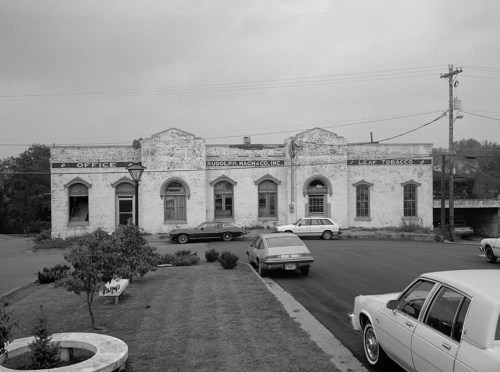
Scene of the Crime: The Washington in its final days. Drastically cut down in the 20th century, it survived as a store and tobacco factory into the 1970’s. A parking lot occupies the site today.


Bryan was later apprehended and tried for the killing, but apparently he was acquitted on grounds of self-defense. However, this wasn’t the last scrape he would become involved in. His next fight would also involve a posh and popular hotel, this time on Nashville’s Public Square. And once more, it would be a duel to the death involving guns, knives, and a secret weapon. What happened?

You can find out in the pages of my book…

Now We’re Rolling…

I’m back after an unexpectedly long hiatus. My apologies. However, we’re just getting started.

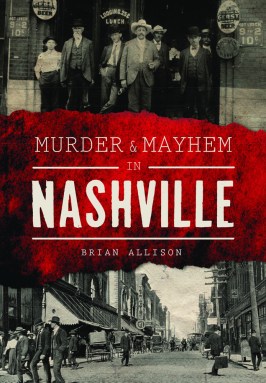
The book at the heart of this whole brouhaha is coming soon (see the snazzy cover below). Street date is October 3rd, and I’m in the process of getting ready for a whole bunch of appearances and talks and signings in the upcoming weeks, so I hope to get to meet and talk to a bunch of you soon. So watch this space. More to come very soon.

Adobe Photoshop PDF

This time I promise 😉

P.S. – If you want to pre-order, you can do it here.


Finally, Milt Goes Down

NOTE: My apologies, this was supposed to be posted back in May with a short disclaimer saying that it would be a while till my next post. That being said, since it has been that while, let’s find out the end to that last saga, shall we?

inigo

Anyway, it’s 1881, and to catch everyone up to speed, Milt Yarberry, dangerously erratic gunman and constable of Albuquerque, NM Territory has just managed to blow away his romantic rival Harry Brown and get away with it. He continued in office for several weeks and managed not to kill anyone else until the afternoon of June 18, 1881.

On that evening, while Milt was talking with a  buddy on the porch of a house, someone fired a shot, probably in a fit of drunken high spirits. Yarberry rushed to the scene and asked who had done it, and when a bystander pointed out a man walking away, Milt unlimbered his .45 Colt and opened up, firing four shots. The man collapsed and witnesses said Milt rejoiced, saying, “I’ve downed the son of a b-—!”

A coroner’s jury established that the deceased, Charles D. Campbell (ironically a Tennessee native like Brown), had been hit by three shots in the chest and the back. Yarberry’s testimony was that Campbell, a railroad employee who was something of a drinker, had pulled a pistol and threatened him and that he had fired – as always in such cases – in self defense. However, the bullet hole in Campbell’s back raised eyebrows, despite Yarberry’s contention that Campbell had spun around when shot and taken the final bullet in that location. For the record, Campbell, though a drunk, had little reputation for violence and no pistol was found on the deceased, although admittedly it might have been removed by a rubbernecker at the scene.

Arrested and tried, Yarberry’s case divided the community of Albuquerque. He had both friends and enemies in the community, and the testimony at the trial was far from clear as to what had happened on that street in the dark. In the end the jury found Milt Yarberry guilty of murder in the first degree, and set his punishment as death by hanging.

Yarberry made an abortive escape attempt but was recaptured, an event that sealed his guilt in some minds. He resigned himself to his fate, playing his fiddle and bragging to the press from his jail cell. He eventually confided to his closest friend, Sheriff Perfecto Armijo, that his real name was Armstrong and that he was born in Arkansas.

On February 9, 1883 he was marched to the gallows – reportedly the same contraption whose construction he had overseen as constable. He made a speech from the platform, and made the cryptic statement that he was being hanged not for killing Campbell, but because he “killed a son of Governor Brown of Tennessee.” When the mask was drawn over his face, he made his final statement: “Gentlemen, you are hanging an innocent man!”

Innocent or not, the mechanism that sprung the trap was put into gear, and moments later  the man who lived as Milton J. Yarberry shot upwards and died. Today, he lies in Albuquerque’s Mount Calvary Cemetery. An impressive tombstone was placed at his head, paid for by his friends.

It was later stolen, and no trace of it exists today.

The Quick and the Dead

After his efforts to foil the robbery of the A.T. & S.F. at Kinsley, Harry Brown received the thanks of his company, and (along with Kinkaide) was hailed as the hero of the hour. He was even given an engraved Winchester rifle as a reward.

Fame seems to have gone to his head, and New Mexico newspapers report that he became an obnoxious braggart in the saloons up and down the line, acting like a goober and bragging of his exploits. He wouldn’t be the first Westerner to let his mouth run wild, but unlike a Bat Masterson or Wild Bill Hickok, his luck couldn’t keep up with his talk.

He was soon a fixture in Albuquerque, where he “hooked up” with a young woman named Sadie Preston. Unfortunately for him, she was already involved with a town constable who went by the unlikely name of Milton J. Yarberry.

Despite his rather goofy sobriquet, Yarberry had a wide reputation as a killer, and it was said he had already gunned down at least three men. Brown, with his own reputation, declared that he wasn’t afraid of Yarberry, who threatened to kill him several times. In retrospect, it seems that Yarberry was what Brown wanted to be – a stone-cold killer. Things came to a head on March 27, 1881.

Brown and Sadie Preston were eating at Girard’s restaurant, while – unbelievably – Yarberry babysat for her, watching her four-year old daughter. The constable soon appeared at the restaurant and led the little girl to her mother, while he and Brown stepped outside to talk.

According to an “ear witness” (a hack driver who had his back to the scene) Brown and Yarberry had a heated discussion, at the conclusion of which Brown stated, “Milt, I want you to understand I am not afraid of you and would not be even if you were Marshal of the United States!” Almost immediately there were gunshots. The hackman turned just in time to see Brown stagger backwards with two bullets in his chest. As he collapsed, Yarberry fired two more into him as he lay on the sidewalk.

Yarberry’s claim was the traditional one – self-defense. He claimed that Brown had been twitchy, trying to get “the drop” on him. When that didn’t work, he said that Brown had slapped him in the face and gone for his gun, and he’d beaten him to the draw. If true, Milt must have been some sort of wizard with a six-gun – witnesses later said that Brown’s pistol was still snugly in its holster when he was carried away. A report in the Nashville press that he had raised up after being shot and stated, “You have murdered me in a cowardly way!” seems unlikely – it looks like Brown was too badly hurt to say anything.

All four of Yarberry’s bullets passed through his body, and he died a short time later. A terse telegram, stating only that “Harry was killed yesterday at 7 o’clock,” was sent to former governor Brown in Nashville, and the young man’s remains were shipped home via Santa Fe and Kansas City. On April 4th, he was buried at Mount Olivet Cemetery, his former friends in the Porter Rifles providing an honor guard for the funeral procession. The grief-stricken father would outlive his son by five years.

Tried for murder, Yarberry was later acquitted. He had many friends who celebrated – but many others in Albuquerque also condemned him as a murderer. Nevertheless, he continued in office as a town constable…at least for the time being.

Next time…the bizarre end of the story of the trigger-happy lawman.

Once Upon a Time in the West

Under a quiet headstone in Mount Olivet Cemetery today rests an honest-to-goodness reminder of the “Wild Wild West” (the real one, not the Will Smith movie). Several western characters passed through Nashville at one time or another, but one of the town’s homegrown gunfighters was actually from a respectable family.

Henry A. Brown was the son of former Whig governor Neill S. Brown, and the nephew of Democrat (and former Confederate general) John Calvin Brown. He lies near his father in the family plot under a headstone that simply bears his name, birth, and death dates. It gives no hint ofthe adventurous life he led.

Born in 1854 at “Idlewild,” his father’s house near Nashville, young Harry grew up during the tumult of the Civil War, during which his father stuck by his guns as one of the most prominent Unionists in town. Following Appomattox he received a good education before turning his sights to the West. In the spring of 1876, the 22-year old Brown joined an exploratory expedition sponsored by Vanderbilt University. He was, said a school chum, “attracted by the promise of the Great West, and…of an adventurous spirit…”

After some time he found employment with the Adams Express Company, one of the nation’s biggest railroad shipping firms, and signed on as an “Express Messenger” – which was a polite way of saying “shotgun guard.” His duty was to protect the property put in charge of the company from bandits and other hazards of the road. This soon put him in close (and uncomfortable) contact with some of the legendary figures of the era.

On the evening January 27, 1878, Brown was aboard an Atchison, Topeka, and Santa Fe train approaching the whistle stop of Kinsley, Kansas. He had a big parcel to deliver at this stop, and as the car shuddered to a halt, he pushed the door open, holding a lantern and idly wondering how to shove the thing onto the platform.

Unknown to him, some drama had been playing out at the station before the train arrived. Six heavily armed gunmen had held up the night man, Andrew Kinkaide, in preparation for robbing the train. Kinkaide broke away just as the train entered the station and despite being shot at, began to scream the alarm. The startled engineer actually missed the stop and managed to bring the train to a halt several hundred yards past the station. Kinkaide’s quick thinking warned the town, the conductor, and the engineer. However, Brown was isolated in his car and didn’t get the message.

When the door on the car swung open, Brown must have been surprised to see no station – just open prairie and six masked men pointing revolvers at him, ordering him to “shell out.” He stared back at them – and then got busy justifying his salary.

Without hesitation Brown threw his lantern into their faces, startling them and darkening the car. He then grabbed his rifle and opened fire. The bandits shot back and for several seconds there was a lively exchange until the engineer managed to get the train out of range. Nobody was hit on either side, and the outlaws eventually gave it up as a bad business and left empty-handed.

Within hours, posses were on the trail, headed by the legendary sheriff of Ford County, Bartholomew “Bat” Masterson – who was technically out of his jurisdiction. However, with his customary energy Masterson quickly rounded up two of the gangsters. Ed West was a nobody but his partner Dave Rudabaugh was destined for minor fame. At trial, Rudabaugh turned on his partners-in-crime and testified against them in exchange for his freedom. Later, “Dirty Dave” joined Billy the Kid’s gang in New Mexico and was supposedly beheaded at Parral in Mexico in 1886 after seriously ticking off the local rowdies. Christian Slater later played him in the movies.

And as for Harry Brown? Tune in next time for the conclusion of his action-packed story.


Original Sin

The Cumberland settlements in the 1780’s were no place for the timid. Killings were an almost daily fact of life, but the violence was almost always from the outside aimed inward. The ongoing war between the Chickasaw, Cherokee, Creek and others against the European interlopers camping on their ancestral hunting ground claimed hundreds of lives, and given the external threat, violent crime between the settlers was very rare.

One or the first (if not the first) known murder in Nashville, involved an old campaigner. Little is known about Solomon White other than a few brief mentions in various sources. He was one of the “Over the Mountain Men” of Watauga who fought with John Sevier at King’s Mountain in 1780. By 1783 he had migrated to the Cumberland country and had claim on a land grant on Red River in what is now Montgomery County south of Guthrie, Kentucky.

Solomon evidently had a temper. The Records of the Superior Court of North Carolina contain the only known record of his crime, which is laid out in the quaint legal language of the day. On June 13, 1786, “being moved and seduced by the instigation of the Devil,” White took a “cutting pole of the value of six pence,” and used it to hit John Harris over the head with it, killing him instantly. [Incidentally, if anyone knows what a “cutting pole” is exactly, let me know. I’m stumped by that one. Drop me a comment if you know.] 

He was indicted for murder, and at his trial in November, 1788 he plead not guilty, and “put himself upon God and his Country.” The proceedings were heard in the first courthouse, an eighteen foot square log house near the old fort on “The Bluffs.” After weighing the evidence the jury found White not guilty of murder, but guilty of manslaughter. Shortly thereafter he was brought before the bar and asked if he had anything to say “why sentence of death should not be passed against him.”

What followed was straight out of English common law, which most of the settlers were familiar with. White pleaded “Benefit of Clergy,” which was granted. Originally, this was a Medieval practice in which the accused proved he could read and write, thereby moving his case from the civil courts into the ecclesiastical courts (in those days, literacy was almost always the realm of the clergy.) In time, however, it came to be used as a “legal fiction,” and a handy way of granting a lesser, but still severe, punishment for a first conviction. If the prisoner was ever brought before the court again, he was also conveniently marked as a repeat offender. In White’s case, he was to be branded on the palm below the thumb with the letter M, signifying manslaughter.

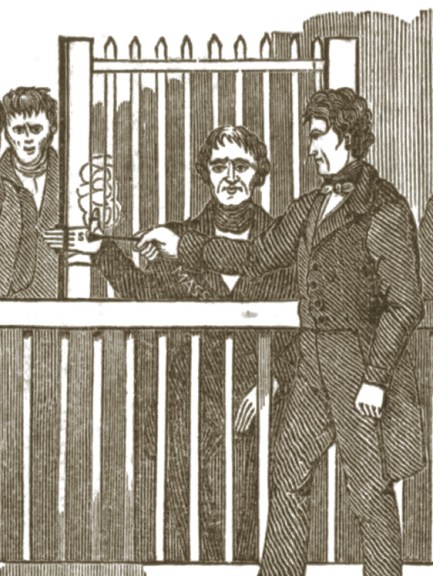
With the exception of the word “State” in the place of “King,” the sentence was carried out exactly according to English judicial procedures: “It is therefore ordered that the said Solomon White be continued at the bar of the Court and there be branded on the brawn of the left thumb with the letter (M) and that the iron be kept thereon until the said Solomon White express the words God Save the State and that the sheriff of Davidson put this sentence in ixecution [sic] immediately in presence of the Court.”

For his sake, one hopes Solomon White was a fast talker.

Branded
Branding – In actuality, I doubt anyone was ever this chill while this was being done to them.

Something’s Afoot

Some of these stories defy logic. Case in point…

December 26, 1864: Nashville was hopping with holiday cheer as well as a celebratory mood. Just ten days earlier, the Union army had won an overwhelming victory over Hood’s Confederate forces outside the city. Many of the combat veterans were in a mood to blow off some steam, and headed into the “jungle” (as one editor called it) of downtown to look for trouble.

As could be imagined, they were a rough bunch and used to rough ways. It was the thankless task of the Provost Marshal’s office to run herd on the boys in blue when they got too out of hand in their fun. Drawn from the many units stationed around the city, these forerunners of the Military Police had to be prepared to deal with all manner of issues as they patrolled their beat.

However, I’m not sure anyone could be prepared to deal with (much less explain) the antics of Private William A. Davidson.

Davidson was a hardened veteran serving with Co. L, 5th Iowa Cavalry, and had just put in a grueling few days’ service chasing Hood out of Tennessee. The morning after Christmas, he was hauled into the Provost office on Cedar Street (now Charlotte Ave.) carrying three odd boots under his arms – none of which had mates.

Seems the little Irishman has a strange “mania” to collect boots that don’t belong to him, and has been arrested three times in the last few months for the same crime. On one occasion he was sentenced to a month in jail and given a stern lecture upon release. Within hours, he was back in custody, carrying another stolen boot.

Lt. Parks of the Provost had run-ins previously with him, and when he spotted Davidson with the purloined footwear, his mouth dropped open. The officer quickly recovered, and  made a shrewd bargain with his suspect. If Parks released him, could Davidson go out and steal the mates to the boots, so that they know where they came from and have all the pieces together at headquarters? Drawing himself up with as much dignity as he can, Davidson responded, “Lieutenant, if you let me off this time, if I don’t bring you the mates of these boots before night, may I be damned!”

Davidson departed on his “mission.” Like any good cop, Parks put a tail on him, apparently hoping to draw out “Mr. Big” and find out where he was getting his supply. In the meantime, the papers advertised that the owner of the three orphan boots might collect them at the Provost office. A grateful soul appeared the following day and claimed his property,  while the newspaper speculated that Davidson would be back with more stolen boots by nightfall. If he was, there was no mention of it. Apparently he ducked his tail and made it back to his unit in the field.

A glance at the records of the 5th Iowa Cavalry yields the fact that Davidson was 22, born in Ireland, and enlisted in the regiment at Ft. Heiman, KY in 1862. He served for the rest of the war and proves a reliable soldier when under arms, seeing action in several campaigns. Despite his odd obsession, he was awarded an honorable discharge at Nashville on June 9, 1865. Apparently he was a good enough trooper that his superiors overlooked his strange hobby.

So what happened to Davidson after his discharge…who knows? Perhaps some diligent researcher combing the newspapers of the Midwest from the 1860’s and ’70’s might yet uncover another chapter in what must be one of the strangest one-man crime waves of the century.


A Pair of Loafers

Difference

One of the interesting things about research is that you never know where the sources will take you.

The Nashville Union gave the following brief notice in its April 9, 1840 issue: “MURDER: James Claxton stabbed a man by the name of Moses Parks at a house of ill fame in this city on Tuesday. Parks died immediately, and Claxton made his escape.”

The New Orleans Times-Picayune shed little additional light on the case, except to take a shot at the character of both men: “They were both loafers.”

For a long time these two brief articles were all I could find on the incident. However, a little searching in the Tennessee State Penitentiary Records and the Circuit Court Minutes at the Tennessee State Library filled in the blanks. What the sources reveal provides an unusually rich slice of the world of gamblers, ladies of the evening, and – yes – “loafers” who could be found in the back alleys of pre-Civil War Nashville.

Jim Claxton was 21 at the time, born and raised in Nashville. 5’9 1/2″ tall, 167 lbs. with black hair, hazel eyes and a dark complexion, he had first been a horse jockey, “until too large.” Thereafter he “followed the River,” working as a deckhand and fireman aboard the many boats plying the Cumberland. He also seems to have been a rough customer, with scars on the left cheek, left leg, and left arm, and had at one point been “Shot in the left arm & leg.” Intriguingly, his mother is said to have kept “a house of ill-fame” on “Vinegar Hill” in Nashville (on the bank of the Cumberland, near the present-day intersection of Adams and Van Buren Streets.) Whether her establishment was the one where the fight happened is not mentioned.

On April 7, 1840 – as loafers often do – he was drinking with cronies in the brothel of Judy Young in Nashville when Moses Parks stormed into the place. Earlier, he’d had a fight with Parks and witnesses edged towards the exits as the two faced off. Parks accused Claxton of ripping his shirt earlier, then reached out and tore the ruffle off the front of Claxton’s own shirt, saying, “Now we are even!”

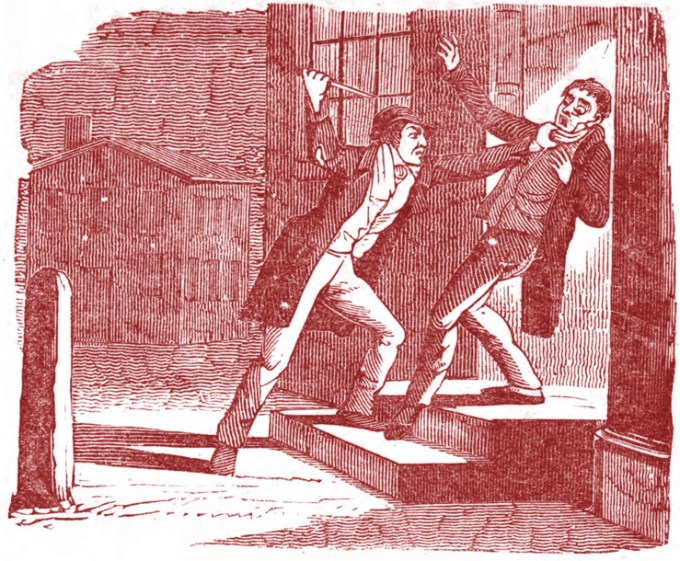
A “hurt and afraid” Claxton responded “[Expletive] Yes we are!” before pulling a clasp knife from his pocket with a blade “about the length of his finger,” and stabbed Parks in the chest. Parks died very shortly thereafter while Claxton made a hasty getaway. He was soon apprehended and taken to jail, charged with murder.

Tried on May 12, 1840, he was found guilty of the lesser charge of manslaughter, and sentenced to 5 years at hard labor in the State Penitentiary. He appealed to the Supreme Court of the state and was granted a hearing. Four days before Christmas they rendered their verdict: Even though the Judge made questionable remarks to the jury during his instructions, the high court ruled he had not actually committed an error. The verdict stood, and the same day Jim Claxton entered the prison on Church Street to start his five year sentence.

He didn’t make it. Like many another, he fell victim to the horrifying conditions within the hell hole that was “Old Red Top.” On March 18, 1844 he died of “marasmus,” or acute malnutrition. To put it another way, just three years into his sentence, the once robust young man had died of starvation.

In a sense, James Claxton and Moses Parks were both tragic nobodies, living and dying in the shadows of Jacksonian Nashville. But the their case serves as a peek into their squalid world, and allows us a more thorough view of the “have nots” as well as the “haves” of the city on the Cumberland in the 1840’s.

It’s also a lesson that not everything is out there on the net…sometimes ya just gotta dig.