It Coulda Happened to Anyone…

Here’s some more late-breaking news from the fall of 1865, as Nashville was beginning to recover from the late Civil War.

It was a crime-ridden season, and among the shootings and stabbings and black-jackings that happened every night in Smoky Row, came this sensational piece of intelligence that seemed to indicate an attempt at mass-murder:

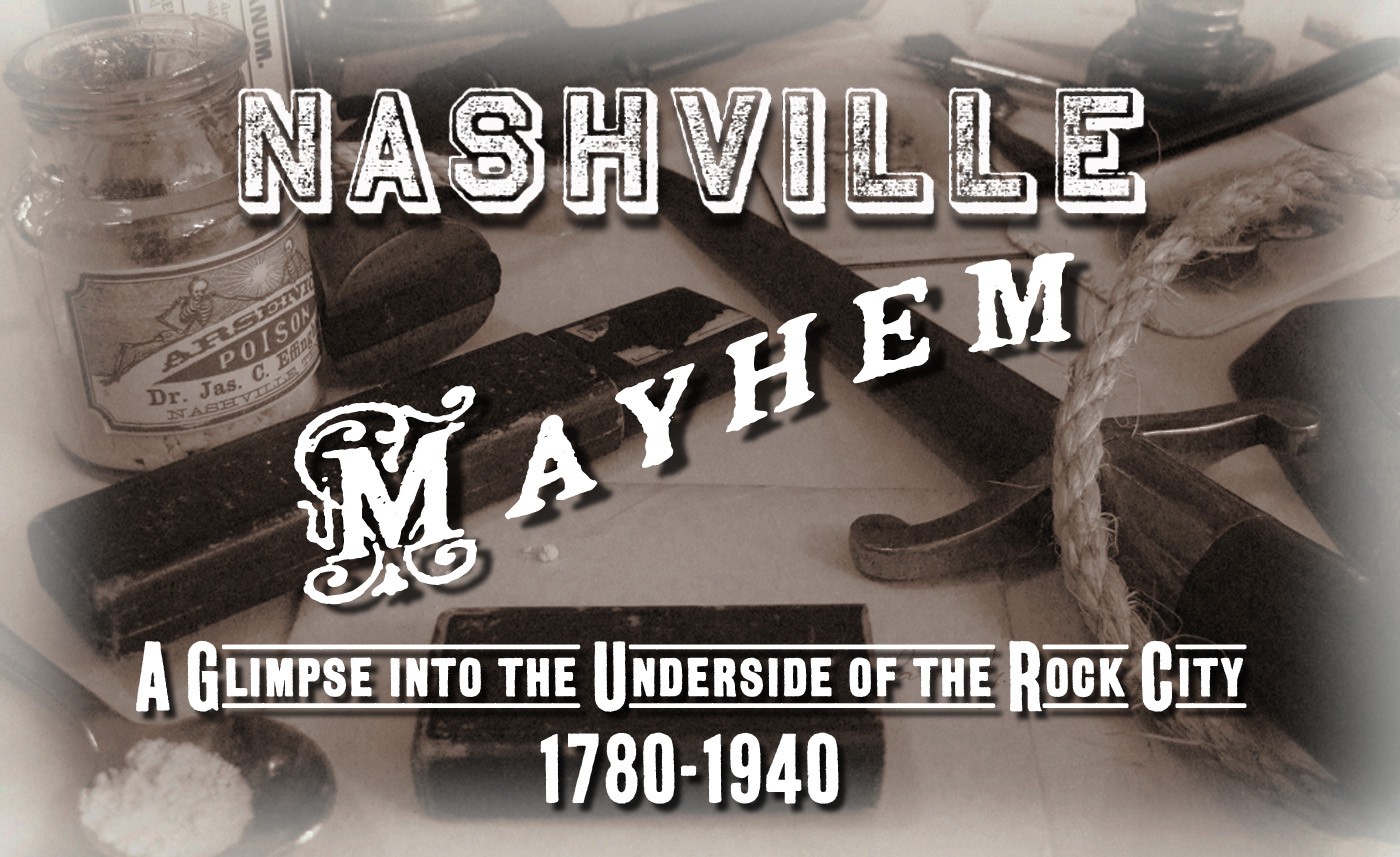
We learned yesterday that a family of six persons living on Line street, were poisoned by a servant girl who used arsenic instead of leaven in making bread. No deaths ensued, but they were a very sick family from the effects of the deadly poison…” [Daily Dispatch, Sep. 30, 1865.]

There was a brief rumble in the press about the incident, with some speculation about whether it was really an accident, which prompted the following remarkable press release:

“To the Editor of the Nashville Dispatch: In yesterday morning’s Dispatch I find some mistakes. It was not done by a servant, as we do not have any. I made the mistake, using arsenic, instead of leaven, at supper time, in the biscuit, and five of the family partook of them, and were made very sick, but it did not prove fatal to any. We are all doing well. It was Mrs. E.V. Wilson’s family, and the mistake was made by her eldest daughter. Very respectfully, Isabella E. Wilson, Corner of Spruce and Line streets.” [Daily Dispatch, Oct. 1, 1865.]

It’s a bizarre story, made more so by the flippant “what will the neighbors think” rebuttal offered by the family. It begs follow-up questions: What was a tub of raw arsenic doing in the kitchen next to the leavening? Who was the lucky one who didn’t “partake” of the biscuits? Was it the eldest daughter? And did that indicate knowledge of the poison beforehand? Was she ever allowed to cook dinner for the family again?

Alas, many questions and no real answers in this obscure family drama. For the record, the address given would today be the corner of Jo Johnston and 8th Avenue…if there was still such an intersection. Rosa L. Parks Blvd. now passes right over the former site of the residence. Isabella E. Wilson is listed, age 30, on the 1860 census, in the same household as 61-year old Eleanor V. Wilson (evidently “Mrs. E.V. Wilson”) and five members of the John. D. Gower family (probably her son-in-law and grandchildren). The author of the note is evidently the one who made the lethal biscuits, and it probably explains its “no harm done” tone.

Just another day in postwar Nashville. More to come…

Speaking on Tuesday…Come One, Come All!

For those of you interested in the book, here’s a chance to get a little preview.

I’ll be speaking at Fort Negley in Nashville on Tuesday, September 27 at the meeting of the Sons of Union Veterans. There will be a business meeting beginning at 6 PM, followed by my presentation at 7 sharp…or as sharp as my notoriously wonky PowerPoint presentations ever go.

The subject will be some of the little-known nastiness that took place at the end of the Civil War in the winter of 1865, when a mixture of bored troops, criminal elements, whiskey, women, and resentful citizens came together in a lethal mix that unleashed one of the city’s worst crime waves before the twentieth century.

The program is free and open to the public, so come on out, say hello, and get a big welcome from the friendly folk of postwar Nashville!

bad-dudes

Bad Boys, Bad Boys…Whatcha gonna do?

Something’s Afoot

Some of these stories defy logic. Case in point…

December 26, 1864: Nashville was hopping with holiday cheer as well as a celebratory mood. Just ten days earlier, the Union army had won an overwhelming victory over Hood’s Confederate forces outside the city. Many of the combat veterans were in a mood to blow off some steam, and headed into the “jungle” (as one editor called it) of downtown to look for trouble.

As could be imagined, they were a rough bunch and used to rough ways. It was the thankless task of the Provost Marshal’s office to run herd on the boys in blue when they got too out of hand in their fun. Drawn from the many units stationed around the city, these forerunners of the Military Police had to be prepared to deal with all manner of issues as they patrolled their beat.

However, I’m not sure anyone could be prepared to deal with (much less explain) the antics of Private William A. Davidson.

Davidson was a hardened veteran serving with Co. L, 5th Iowa Cavalry, and had just put in a grueling few days’ service chasing Hood out of Tennessee. The morning after Christmas, he was hauled into the Provost office on Cedar Street (now Charlotte Ave.) carrying three odd boots under his arms – none of which had mates.

Seems the little Irishman has a strange “mania” to collect boots that don’t belong to him, and has been arrested three times in the last few months for the same crime. On one occasion he was sentenced to a month in jail and given a stern lecture upon release. Within hours, he was back in custody, carrying another stolen boot.

Lt. Parks of the Provost had run-ins previously with him, and when he spotted Davidson with the purloined footwear, his mouth dropped open. The officer quickly recovered, and  made a shrewd bargain with his suspect. If Parks released him, could Davidson go out and steal the mates to the boots, so that they know where they came from and have all the pieces together at headquarters? Drawing himself up with as much dignity as he can, Davidson responded, “Lieutenant, if you let me off this time, if I don’t bring you the mates of these boots before night, may I be damned!”

Davidson departed on his “mission.” Like any good cop, Parks put a tail on him, apparently hoping to draw out “Mr. Big” and find out where he was getting his supply. In the meantime, the papers advertised that the owner of the three orphan boots might collect them at the Provost office. A grateful soul appeared the following day and claimed his property,  while the newspaper speculated that Davidson would be back with more stolen boots by nightfall. If he was, there was no mention of it. Apparently he ducked his tail and made it back to his unit in the field.

A glance at the records of the 5th Iowa Cavalry yields the fact that Davidson was 22, born in Ireland, and enlisted in the regiment at Ft. Heiman, KY in 1862. He served for the rest of the war and proves a reliable soldier when under arms, seeing action in several campaigns. Despite his odd obsession, he was awarded an honorable discharge at Nashville on June 9, 1865. Apparently he was a good enough trooper that his superiors overlooked his strange hobby.

So what happened to Davidson after his discharge…who knows? Perhaps some diligent researcher combing the newspapers of the Midwest from the 1860’s and ’70’s might yet uncover another chapter in what must be one of the strangest one-man crime waves of the century.