Sunday, Sunday, Sunday…

And Saturday, Saturday, Saturday…Big weekend this time around, so drop in to talk if you get the chance.

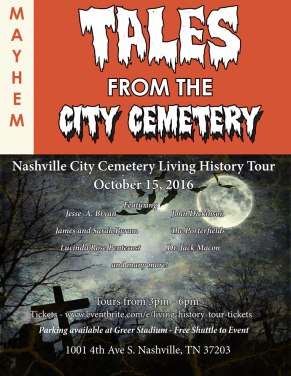
Today (Saturday the 15th), from 3-6 PM,  I’ll be selling and signing books at the Nashville City Cemetery tour. They’re featuring stories of seasonal creepiness based on folks who came to an untimely end. Should be a lively tour, and I’ll be there in case you want some additional atmosphere to take home and read at leisure. Check out their awesome flyer below, or at this link:

mayhemcrypt3

If you can’t make it today, I’ll be at the Southern Festival of Books tomorrow (Sunday the 16th), Legislative Plaza, Room 12 from 3-4 PM. Myself and James D. Squires, author of West End, will be co-panelists talking about Back Rooms and Back Alleys: Tales from Old Nashville, followed by a book signing. They’re forecasting a lovely day, so come out and hear stories of Nashville’s past from a couple of folks who helped move the rock (so to speak). Get more information here.

Hope to see you there!


Upcoming Event

BTW, if you like the story about Jesse Bryan that I posted, you ought to come out to see the Nashville City Cemetery’s annual tour on October 15, from 3:00 to 7:00 PM, with the last tour leaving at 6.

Interpreters will be posted throughout the cemetery, portraying a selection of those interred there, and the theme this year revolves around some of the more tragic figures in the cemetery, as well as some of the…naughtier ones, shall we say? Should be a lively lineup.

And one of those on the roster is Mr. Bryan, who I’ve already blogged about, so you can hear the rest of his story – or at least his version of it 🙂  As an added bonus, you can come see me there as well – I’ll be on hand to sign my book and meet and greet, so come on out and see me after you enjoy the tour!

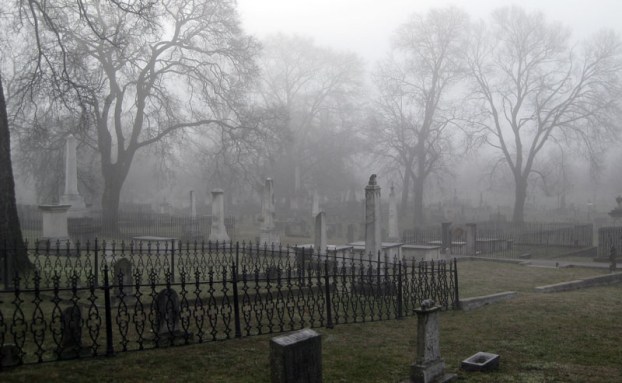
spooky-pic
Trust me, it really looks this spooky.

Finally, Milt Goes Down

NOTE: My apologies, this was supposed to be posted back in May with a short disclaimer saying that it would be a while till my next post. That being said, since it has been that while, let’s find out the end to that last saga, shall we?
inigo

Anyway, it’s 1881, and to catch everyone up to speed, Milt Yarberry, dangerously erratic gunman and constable of Albuquerque, NM Territory has just managed to blow away his romantic rival Harry Brown and get away with it. He continued in office for several weeks and managed not to kill anyone else until the afternoon of June 18, 1881.

On that evening, while Milt was talking with a  buddy on the porch of a house, someone fired a shot, probably in a fit of drunken high spirits. Yarberry rushed to the scene and asked who had done it, and when a bystander pointed out a man walking away, Milt unlimbered his .45 Colt and opened up, firing four shots. The man collapsed and witnesses said Milt rejoiced, saying, “I’ve downed the son of a b-—!”

A coroner’s jury established that the deceased, Charles D. Campbell (ironically a Tennessee native like Brown), had been hit by three shots in the chest and the back. Yarberry’s testimony was that Campbell, a railroad employee who was something of a drinker, had pulled a pistol and threatened him and that he had fired – as always in such cases – in self defense. However, the bullet hole in Campbell’s back raised eyebrows, despite Yarberry’s contention that Campbell had spun around when shot and taken the final bullet in that location. For the record, Campbell, though a drunk, had little reputation for violence and no pistol was found on the deceased, although admittedly it might have been removed by a rubbernecker at the scene.

Arrested and tried, Yarberry’s case divided the community of Albuquerque. He had both friends and enemies in the community, and the testimony at the trial was far from clear as to what had happened on that street in the dark. In the end the jury found Milt Yarberry guilty of murder in the first degree, and set his punishment as death by hanging.

Yarberry made an abortive escape attempt but was recaptured, an event that sealed his guilt in some minds. He resigned himself to his fate, playing his fiddle and bragging to the press from his jail cell. He eventually confided to his closest friend, Sheriff Perfecto Armijo, that his real name was Armstrong and that he was born in Arkansas.

On February 9, 1883 he was marched to the gallows – reportedly the same contraption whose construction he had overseen as constable. He made a speech from the platform, and made the cryptic statement that he was being hanged not for killing Campbell, but because he “killed a son of Governor Brown of Tennessee.” When the mask was drawn over his face, he made his final statement: “Gentlemen, you are hanging an innocent man!”

Innocent or not, the mechanism that sprung the trap was put into gear, and moments later  the man who lived as Milton J. Yarberry shot upwards and died. Today, he lies in Albuquerque’s Mount Calvary Cemetery. An impressive tombstone was placed at his head, paid for by his friends.

It was later stolen, and no trace of it exists today.
The Quick and the Dead

After his efforts to foil the robbery of the A.T. & S.F. at Kinsley, Harry Brown received the thanks of his company, and (along with Kinkaide) was hailed as the hero of the hour. He was even given an engraved Winchester rifle as a reward.

Fame seems to have gone to his head, and New Mexico newspapers report that he became an obnoxious braggart in the saloons up and down the line, acting like a goober and bragging of his exploits. He wouldn’t be the first Westerner to let his mouth run wild, but unlike a Bat Masterson or Wild Bill Hickok, his luck couldn’t keep up with his talk.

He was soon a fixture in Albuquerque, where he “hooked up” with a young woman named Sadie Preston. Unfortunately for him, she was already involved with a town constable who went by the unlikely name of Milton J. Yarberry.

Despite his rather goofy sobriquet, Yarberry had a wide reputation as a killer, and it was said he had already gunned down at least three men. Brown, with his own reputation, declared that he wasn’t afraid of Yarberry, who threatened to kill him several times. In retrospect, it seems that Yarberry was what Brown wanted to be – a stone-cold killer. Things came to a head on March 27, 1881.

Brown and Sadie Preston were eating at Girard’s restaurant, while – unbelievably – Yarberry babysat for her, watching her four-year old daughter. The constable soon appeared at the restaurant and led the little girl to her mother, while he and Brown stepped outside to talk.

According to an “ear witness” (a hack driver who had his back to the scene) Brown and Yarberry had a heated discussion, at the conclusion of which Brown stated, “Milt, I want you to understand I am not afraid of you and would not be even if you were Marshal of the United States!” Almost immediately there were gunshots. The hackman turned just in time to see Brown stagger backwards with two bullets in his chest. As he collapsed, Yarberry fired two more into him as he lay on the sidewalk.

Yarberry’s claim was the traditional one – self-defense. He claimed that Brown had been twitchy, trying to get “the drop” on him. When that didn’t work, he said that Brown had slapped him in the face and gone for his gun, and he’d beaten him to the draw. If true, Milt must have been some sort of wizard with a six-gun – witnesses later said that Brown’s pistol was still snugly in its holster when he was carried away. A report in the Nashville press that he had raised up after being shot and stated, “You have murdered me in a cowardly way!” seems unlikely – it looks like Brown was too badly hurt to say anything.

All four of Yarberry’s bullets passed through his body, and he died a short time later. A terse telegram, stating only that “Harry was killed yesterday at 7 o’clock,” was sent to former governor Brown in Nashville, and the young man’s remains were shipped home via Santa Fe and Kansas City. On April 4th, he was buried at Mount Olivet Cemetery, his former friends in the Porter Rifles providing an honor guard for the funeral procession. The grief-stricken father would outlive his son by five years.

Tried for murder, Yarberry was later acquitted. He had many friends who celebrated – but many others in Albuquerque also condemned him as a murderer. Nevertheless, he continued in office as a town constable…at least for the time being.

Next time…the bizarre end of the story of the trigger-happy lawman.

Once Upon a Time in the West

Under a quiet headstone in Mount Olivet Cemetery today rests an honest-to-goodness reminder of the “Wild Wild West” (the real one, not the Will Smith movie). Several western characters passed through Nashville at one time or another, but one of the town’s homegrown gunfighters was actually from a respectable family.

Henry A. Brown was the son of former Whig governor Neill S. Brown, and the nephew of Democrat (and former Confederate general) John Calvin Brown. He lies near his father in the family plot under a headstone that simply bears his name, birth, and death dates. It gives no hint ofthe adventurous life he led.

Born in 1854 at “Idlewild,” his father’s house near Nashville, young Harry grew up during the tumult of the Civil War, during which his father stuck by his guns as one of the most prominent Unionists in town. Following Appomattox he received a good education before turning his sights to the West. In the spring of 1876, the 22-year old Brown joined an exploratory expedition sponsored by Vanderbilt University. He was, said a school chum, “attracted by the promise of the Great West, and…of an adventurous spirit…”

After some time he found employment with the Adams Express Company, one of the nation’s biggest railroad shipping firms, and signed on as an “Express Messenger” – which was a polite way of saying “shotgun guard.” His duty was to protect the property put in charge of the company from bandits and other hazards of the road. This soon put him in close (and uncomfortable) contact with some of the legendary figures of the era.

On the evening January 27, 1878, Brown was aboard an Atchison, Topeka, and Santa Fe train approaching the whistle stop of Kinsley, Kansas. He had a big parcel to deliver at this stop, and as the car shuddered to a halt, he pushed the door open, holding a lantern and idly wondering how to shove the thing onto the platform.

Unknown to him, some drama had been playing out at the station before the train arrived. Six heavily armed gunmen had held up the night man, Andrew Kinkaide, in preparation for robbing the train. Kinkaide broke away just as the train entered the station and despite being shot at, began to scream the alarm. The startled engineer actually missed the stop and managed to bring the train to a halt several hundred yards past the station. Kinkaide’s quick thinking warned the town, the conductor, and the engineer. However, Brown was isolated in his car and didn’t get the message.

When the door on the car swung open, Brown must have been surprised to see no station – just open prairie and six masked men pointing revolvers at him, ordering him to “shell out.” He stared back at them – and then got busy justifying his salary.

Without hesitation Brown threw his lantern into their faces, startling them and darkening the car. He then grabbed his rifle and opened fire. The bandits shot back and for several seconds there was a lively exchange until the engineer managed to get the train out of range. Nobody was hit on either side, and the outlaws eventually gave it up as a bad business and left empty-handed.

Within hours, posses were on the trail, headed by the legendary sheriff of Ford County, Bartholomew “Bat” Masterson – who was technically out of his jurisdiction. However, with his customary energy Masterson quickly rounded up two of the gangsters. Ed West was a nobody but his partner Dave Rudabaugh was destined for minor fame. At trial, Rudabaugh turned on his partners-in-crime and testified against them in exchange for his freedom. Later, “Dirty Dave” joined Billy the Kid’s gang in New Mexico and was supposedly beheaded at Parral in Mexico in 1886 after seriously ticking off the local rowdies. Christian Slater later played him in the movies.

And as for Harry Brown? Tune in next time for the conclusion of his action-packed story.


It’s A Beautiful Day in the Neighborhood…

As a follow up, here’s a quaint item illustrating exactly how fragrant the vicinity of Lt. Chandler’s penultimate resting place had become by the time they moved the tomb:

“Cephus McStravick, evidently a sporting gentleman, fond of fire arms, was arrested for indulging his ruling passion in unlawful, not to say exceedingly dangerous manner. It appears that Cephus was passing through the jungles in the neighborhood of the Sulphur Spring, when his eye rested upon a woman standing at a second story window of one of the houses in that locality. Cephus expressed himself to the effect that she offered a good mark for his pistol, which he drew. The woman dodged, but defendant fired, and his ball passed through an adjoining window and into an apartment which was fortunately tenantless at that moment. The Court regarded the offence as a flagrant one, and inflicted the highest penalty in its power, $50 and costs.”

[“Police Court,” Nashville, TN Republican Banner, Apr. 23, 1857.]

So…a gambler uses a woman at a brothel window for target practice. Just another fine day in the “jungles.”

And also…”Cephus McStravick?” Really?

Tune in next time…

Old Soldiers Fade Away – Part 2

According to an old timer, Chandler’s was the first grave at the Sulphur Spring, in an isolated grove on land deemed unsuitable for farming. Chandler had come into town in poor health from an outpost (possibly Fort Southwest Point) and died at Talbot’s Tavern on Public Square. His burial took place on a snowy day in late December, 1801, with a small contingent of citizens and army officers in attendance. They hoped that it would prove a suitable location for his final resting place. They were wrong.

By 1859, the vicinity around the grave of Lt. Chandler had become – to put it mildly – an eyesore. The once genteel public park had become the hangout of “disreputable” sorts, a popular trysting point for adventurous couples. It was apparently some of these ne’er-do-wells who had vandalized the old grave in the first place, breaking two feet of the slab off the stone lid.

Due to the deteriorating condition of the area, a motion was forwarded to the City Council by the Tennessee Historical Society to reinter the lieutenant’s remains in Mount Olivet Cemetery in a more fitting manner. September 23rd was named as moving day.

It was quite a to-do. Major Adolphus Heiman, the noted architect, was named as the Marshal of the ceremony, and Edward East of the City Council was named speaker. The cadets from the University of Nashville Military Academy were invited, but apparently declined. However, the “German Yagers” (sic – Jägers) probably a light infantry militia  company from Germantown, provided an escort. The body was exhumed at around 9 A.M.

To everyone’s surprise, despite the frequent floods that had washed over the crypt, the skeleton was intact, and the papers noted that badly-healed breaks in the right arm and leg showed that the lieutenant had “passed through some rough scenes” during his service. The bones were placed in a velvet-lined casket with thirteen silver stars on it.

At 2:00 P.M. the remains were escorted from Public Square to McKendree Church where the funeral service was read by Rev. Charles T. Quintard (soon to be noted as a leading Confederate chaplain). From there it was on to Mount Olivet, the body escorted by veterans of 1812, the Seminole War, and the Mexican War. September 23 was the anniversary of the Battle of Monterey, Mexico, making it doubly meaningful for the old soldiers.

Chandler was buried beneath a tree on a high hill in the new cemetery, to the accompaniment of a twenty-one gun salute fired by the “Yagers.” The old stone sarcophagus was too far gone to save, but the plans were to put an appropriate new marker over his grave.

And then the Civil War happened. And apparently all that was forgotten.

Today, Chandler remains unmarked, more than 150 years after his second funeral. I made a search recently for him, and the records indicate that he’s buried in Plot No. 118, Section No. 1. The problem is…there is no 118.

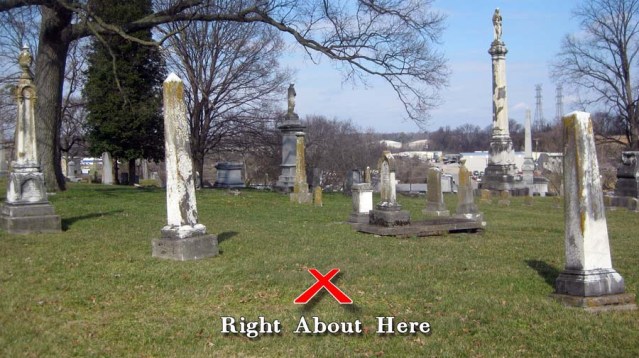
The numbered plots seem to end with 117. As far as anyone can tell, this earliest of Nashville burials lies today in an unmarked grave, probably next to the old sunken “Hearse Road” that runs through Section 1. The photo below shows the approximate spot.

Chandler

Perhaps one day his resting place can be confirmed and a suitable marker placed above his grave. But for right now, one of Nashville’s links to its frontier past lies forgotten, surrounded by elegant Victorian markers from a more “settled” time.

More to come next time.


Old Soldiers Fade Away – Part 1

ANNND, we’re back. Sorry ’bout that. I’ll try not to be away that long again.

Our next tale involves neither murder nor mayhem, but an interesting tale about a grave that was lost…then found…then lost once more. And therein lies some information on Nashville’s earliest graveyard and its current rebirth into…something else.

Five days before Christmas in 1801, a soldier died in Nashville. Lieutenant Richard Chandler was the paymaster of the 4th U.S. Infantry, and a veteran of the many wars fought in the “Northwest Territory” (modern-day Ohio). Originally from Virginia, he was commissioned an Ensign in the 4th Sub-Legion on May 12, 1794, and in August of that year he fought with “Mad Anthony” Wayne at the bloody Battle of Fallen Timbers. He was made paymaster on July 22, 1795.  When the 4th Sub-Legion was re-designated the 4th Infantry on Nov. 1, 1796, Chandler went with it. He was promoted to 1st Lieutenant on July 31, 1798, still acting as paymaster. During this period, he did outpost duty with his command, manning far-flung posts in Tennessee and Georgia.

After Chandler’s untimely death he was interred in an impressive stone-box tomb in the town’s burying ground, which at that time was along the banks of the now-vanished Lick Branch near the Sulphur Spring. This ad-hoc cemetery grew rapidly after the first settlers began to die under the musket balls and tomahawks of the Chickasaw, Cherokee, and Creek warriors of the 1780s.

In 1822 the new City Cemetery was founded, and the old one fell out of fashion. Gradually it fell into decay as the Sulphur Spring was reinvented as the town’s new pleasure gardens. If the original graves weren’t relocated into the new cemetery, they were gradually overgrown and forgotten.

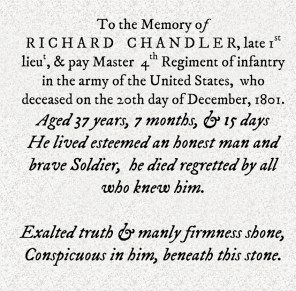
Chandler was lucky. Just as the Civil War was looming on the horizon a new interest in the early pioneers manifested itself, and a movement developed to preserve some of the relics of that age. On July 7, 1859 several sketches were made of the old burial. The worn epitaph was recorded thusly:

Chandler Inscription


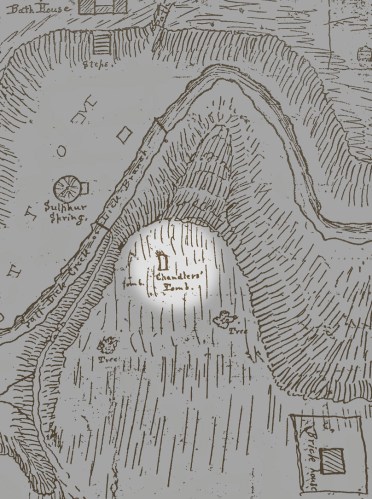
The location of the tomb was also sketched:

Chandler's Tomb

It’s a remarkable snapshot of a long vanished Nashville staple – up until the Civil War and after “the Springs” were where folks of all walks of life went to pass time, and to be seen and see. Long before baseball settled there in the late 19th century, it was Nashville’s first public park. The tomb stood across the branch from the Springhouse itself, on a tall spit of land  at the end of Cherry Street (now 4th Ave.)

The sketch is not to scale, but by comparison with other maps done about the same time (the Army was very interested in correct cartography during the Late Unpleasantness), it is possible to come close. The location appears to be somewhere in the parking lot of the new First Tennessee Park baseball stadium.

Needless to say, there is little left to remind one of the spot’s 19th century appearance today, but the next time you attend a game there, hopefully you can have a new appreciation for the history of the spot as you trudge wearily towards your car under a hot summer sun.

As to Chandler, what happened to him? In 1859 a “memorial” was given to City Council, proposing to move the grave “to either the City Cemetery or to Mt. Olivet…”

More on that next time.


All Around the Town

Nashville, like many cities, has a checkered relationship with its past. History often makes way for the new, and what remains is often hidden beneath layers of modern development. There are plenty of hidden slices of the past around the city, often in the most unusual locations. Every week, I’ll try to share some of the sites that this project has brought me in contact with.

First up, we have the Soldiers’ Rest Cemetery. This tiny plot is all that remains of the plantation of Gen. Thomas Overton (1753-1824), a veteran of the Revolutionary War. Overton served for  seven years with Washington’s army, originally in the 9th Virginia Regiment, and later with the 4th Continental Light Dragoons, seeing action at places like Germantown, Monmouth, and Yorktown, as well as wintering at Valley Forge. He moved to Tennessee around 1804, and founded a farm not far from that of Andrew Jackson. The two struck up a lifelong friendship. In fact, Overton later stood as Jackson’s second in his duel with Charles Dickinson in 1806.

The cemetery today stands in a small lot surrounded by houses and businesses near the intersection of Donelson Avenue and Old Hickory Boulevard. I visited it the day after Halloween, and was greeted by a coal black cat who followed me around the entire time, just…watching me. After thanking him, I doused myself and my car with holy water and took my leave.

This little plot once stood close to Overton’s mansion, appropriately named “Soldier’s Rest,” which was the centerpiece of his sprawling plantation. What brought me here? Well, in the fall of 1819 Overton’s place became the scene of a remarkable drama when his overseer was murdered by one of the slaves who worked on the farm. During the ensuing investigation, the slain overseer’s wife was accused of conspiring with the slave to kill her husband.

So what happened next?

Well, that’s why I want you to pick up a copy of the book when it comes out 🙂

For more information about Overton, here’s his page on the great oracle Wikipedia: https://en.wikipedia.org/wiki/Thomas_Overton