It’s A Beautiful Day in the Neighborhood…

As a follow up, here’s a quaint item illustrating exactly how fragrant the vicinity of Lt. Chandler’s penultimate resting place had become by the time they moved the tomb:

“Cephus McStravick, evidently a sporting gentleman, fond of fire arms, was arrested for indulging his ruling passion in unlawful, not to say exceedingly dangerous manner. It appears that Cephus was passing through the jungles in the neighborhood of the Sulphur Spring, when his eye rested upon a woman standing at a second story window of one of the houses in that locality. Cephus expressed himself to the effect that she offered a good mark for his pistol, which he drew. The woman dodged, but defendant fired, and his ball passed through an adjoining window and into an apartment which was fortunately tenantless at that moment. The Court regarded the offence as a flagrant one, and inflicted the highest penalty in its power, $50 and costs.”

[“Police Court,” Nashville, TN Republican Banner, Apr. 23, 1857.]

So…a gambler uses a woman at a brothel window for target practice. Just another fine day in the “jungles.”

And also…”Cephus McStravick?” Really?

Tune in next time…

Old Soldiers Fade Away – Part 2

According to an old timer, Chandler’s was the first grave at the Sulphur Spring, in an isolated grove on land deemed unsuitable for farming. Chandler had come into town in poor health from an outpost (possibly Fort Southwest Point) and died at Talbot’s Tavern on Public Square. His burial took place on a snowy day in late December, 1801, with a small contingent of citizens and army officers in attendance. They hoped that it would prove a suitable location for his final resting place. They were wrong.

By 1859, the vicinity around the grave of Lt. Chandler had become – to put it mildly – an eyesore. The once genteel public park had become the hangout of “disreputable” sorts, a popular trysting point for adventurous couples. It was apparently some of these ne’er-do-wells who had vandalized the old grave in the first place, breaking two feet of the slab off the stone lid.

Due to the deteriorating condition of the area, a motion was forwarded to the City Council by the Tennessee Historical Society to reinter the lieutenant’s remains in Mount Olivet Cemetery in a more fitting manner. September 23rd was named as moving day.

It was quite a to-do. Major Adolphus Heiman, the noted architect, was named as the Marshal of the ceremony, and Edward East of the City Council was named speaker. The cadets from the University of Nashville Military Academy were invited, but apparently declined. However, the “German Yagers” (sic – Jägers) probably a light infantry militia  company from Germantown, provided an escort. The body was exhumed at around 9 A.M.

To everyone’s surprise, despite the frequent floods that had washed over the crypt, the skeleton was intact, and the papers noted that badly-healed breaks in the right arm and leg showed that the lieutenant had “passed through some rough scenes” during his service. The bones were placed in a velvet-lined casket with thirteen silver stars on it.

At 2:00 P.M. the remains were escorted from Public Square to McKendree Church where the funeral service was read by Rev. Charles T. Quintard (soon to be noted as a leading Confederate chaplain). From there it was on to Mount Olivet, the body escorted by veterans of 1812, the Seminole War, and the Mexican War. September 23 was the anniversary of the Battle of Monterey, Mexico, making it doubly meaningful for the old soldiers.

Chandler was buried beneath a tree on a high hill in the new cemetery, to the accompaniment of a twenty-one gun salute fired by the “Yagers.” The old stone sarcophagus was too far gone to save, but the plans were to put an appropriate new marker over his grave.

And then the Civil War happened. And apparently all that was forgotten.

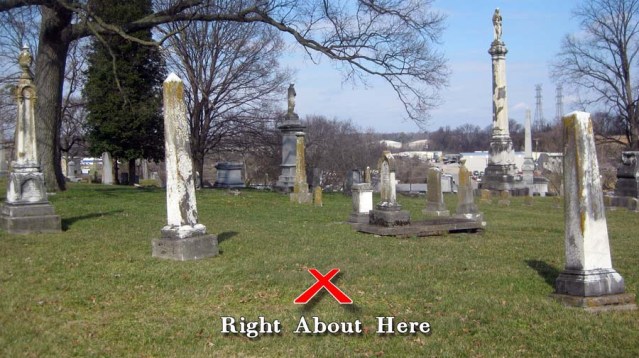
Today, Chandler remains unmarked, more than 150 years after his second funeral. I made a search recently for him, and the records indicate that he’s buried in Plot No. 118, Section No. 1. The problem is…there is no 118.

The numbered plots seem to end with 117. As far as anyone can tell, this earliest of Nashville burials lies today in an unmarked grave, probably next to the old sunken “Hearse Road” that runs through Section 1. The photo below shows the approximate spot.

Chandler

Perhaps one day his resting place can be confirmed and a suitable marker placed above his grave. But for right now, one of Nashville’s links to its frontier past lies forgotten, surrounded by elegant Victorian markers from a more “settled” time.

More to come next time.


Old Soldiers Fade Away – Part 1

ANNND, we’re back. Sorry ’bout that. I’ll try not to be away that long again.

Our next tale involves neither murder nor mayhem, but an interesting tale about a grave that was lost…then found…then lost once more. And therein lies some information on Nashville’s earliest graveyard and its current rebirth into…something else.

Five days before Christmas in 1801, a soldier died in Nashville. Lieutenant Richard Chandler was the paymaster of the 4th U.S. Infantry, and a veteran of the many wars fought in the “Northwest Territory” (modern-day Ohio). Originally from Virginia, he was commissioned an Ensign in the 4th Sub-Legion on May 12, 1794, and in August of that year he fought with “Mad Anthony” Wayne at the bloody Battle of Fallen Timbers. He was made paymaster on July 22, 1795.  When the 4th Sub-Legion was re-designated the 4th Infantry on Nov. 1, 1796, Chandler went with it. He was promoted to 1st Lieutenant on July 31, 1798, still acting as paymaster. During this period, he did outpost duty with his command, manning far-flung posts in Tennessee and Georgia.

After Chandler’s untimely death he was interred in an impressive stone-box tomb in the town’s burying ground, which at that time was along the banks of the now-vanished Lick Branch near the Sulphur Spring. This ad-hoc cemetery grew rapidly after the first settlers began to die under the musket balls and tomahawks of the Chickasaw, Cherokee, and Creek warriors of the 1780s.

In 1822 the new City Cemetery was founded, and the old one fell out of fashion. Gradually it fell into decay as the Sulphur Spring was reinvented as the town’s new pleasure gardens. If the original graves weren’t relocated into the new cemetery, they were gradually overgrown and forgotten.

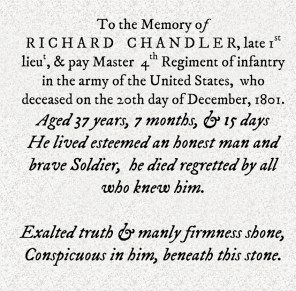
Chandler was lucky. Just as the Civil War was looming on the horizon a new interest in the early pioneers manifested itself, and a movement developed to preserve some of the relics of that age. On July 7, 1859 several sketches were made of the old burial. The worn epitaph was recorded thusly:

Chandler Inscription


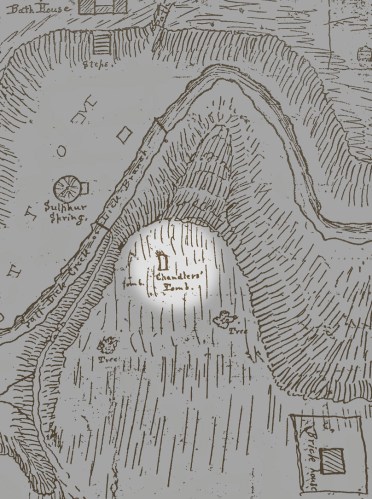
The location of the tomb was also sketched:

Chandler's Tomb

It’s a remarkable snapshot of a long vanished Nashville staple – up until the Civil War and after “the Springs” were where folks of all walks of life went to pass time, and to be seen and see. Long before baseball settled there in the late 19th century, it was Nashville’s first public park. The tomb stood across the branch from the Springhouse itself, on a tall spit of land  at the end of Cherry Street (now 4th Ave.)

The sketch is not to scale, but by comparison with other maps done about the same time (the Army was very interested in correct cartography during the Late Unpleasantness), it is possible to come close. The location appears to be somewhere in the parking lot of the new First Tennessee Park baseball stadium.

Needless to say, there is little left to remind one of the spot’s 19th century appearance today, but the next time you attend a game there, hopefully you can have a new appreciation for the history of the spot as you trudge wearily towards your car under a hot summer sun.

As to Chandler, what happened to him? In 1859 a “memorial” was given to City Council, proposing to move the grave “to either the City Cemetery or to Mt. Olivet…”

More on that next time.


Back In the Saddle…


Posse

For those who have stopped by recently and noticed a lack of activity…you’re right. My apologies. That’s about to change.

It’s been Deadline Time ™ around these parts and that’s taken up all my energy the past few weeks. The good news is that as of this afternoon the manuscript that lies behind this blog is officially submitted! It’s now winging its way to my editor, so that she can start carving it into a book.

That means I can get back to posting some cool stuff here, so if you’re looking for your daily dose of interesting historical facts, stay tuned. We should be back on track by Monday.

Watch this space…


Requiem for Ike

One hundred years ago today an era of Nashville history came to a close.

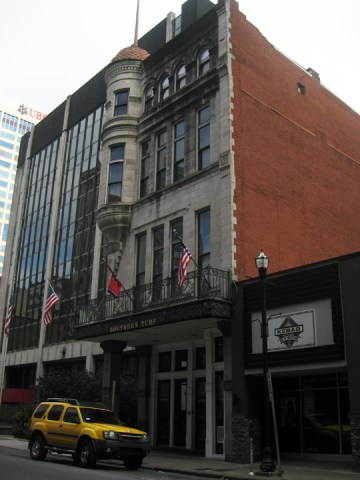
On the morning of February 3, 1916 former gambler and saloon keeper Ike Johnson committed suicide in his room at the Southern Turf building on 4th Avenue, just days before he was to be evicted from the room where he had lived for the previous twenty years.

Ike had been one of the leading lights of the Gilded Age saloon scene in town, owning and operating some of the “toniest” establishments in the city, only to lose it all when Prohibition was enacted following the killing of his old nemesis, Senator Edward Ward Carmack, in 1908.

He was known as a glittering tough, a generous gambler, an abstemious saloon man, and a lifelong bachelor with a soft heart for children and animals. And though he himself said that “It is not good for a man to live the way I have lived,” his passing was mourned by even those opposed to his lifestyle. With his death, one of the last links to Nashville’s opulent Victorian highlife was severed.

He rests today in a quiet spot in Mount Olivet Cemetery. His palace, the Southern Turf, still lives on today, reincarnated as a modern office building. It is one of the last reminders of the old “Gentleman’s Quarter,” where nighttime never seemed to fall before 1900.

ST Small
Ike Johnson’s Last Stand: The Southern Turf Building on 4th Avenue.

Original Sin

The Cumberland settlements in the 1780’s were no place for the timid. Killings were an almost daily fact of life, but the violence was almost always from the outside aimed inward. The ongoing war between the Chickasaw, Cherokee, Creek and others against the European interlopers camping on their ancestral hunting ground claimed hundreds of lives, and given the external threat, violent crime between the settlers was very rare.

One or the first (if not the first) known murder in Nashville, involved an old campaigner. Little is known about Solomon White other than a few brief mentions in various sources. He was one of the “Over the Mountain Men” of Watauga who fought with John Sevier at King’s Mountain in 1780. By 1783 he had migrated to the Cumberland country and had claim on a land grant on Red River in what is now Montgomery County south of Guthrie, Kentucky.

Solomon evidently had a temper. The Records of the Superior Court of North Carolina contain the only known record of his crime, which is laid out in the quaint legal language of the day. On June 13, 1786, “being moved and seduced by the instigation of the Devil,” White took a “cutting pole of the value of six pence,” and used it to hit John Harris over the head with it, killing him instantly. [Incidentally, if anyone knows what a “cutting pole” is exactly, let me know. I’m stumped by that one. Drop me a comment if you know.] 

He was indicted for murder, and at his trial in November, 1788 he plead not guilty, and “put himself upon God and his Country.” The proceedings were heard in the first courthouse, an eighteen foot square log house near the old fort on “The Bluffs.” After weighing the evidence the jury found White not guilty of murder, but guilty of manslaughter. Shortly thereafter he was brought before the bar and asked if he had anything to say “why sentence of death should not be passed against him.”

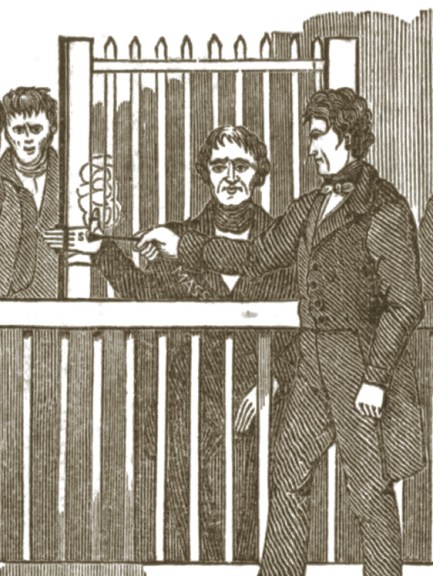
What followed was straight out of English common law, which most of the settlers were familiar with. White pleaded “Benefit of Clergy,” which was granted. Originally, this was a Medieval practice in which the accused proved he could read and write, thereby moving his case from the civil courts into the ecclesiastical courts (in those days, literacy was almost always the realm of the clergy.) In time, however, it came to be used as a “legal fiction,” and a handy way of granting a lesser, but still severe, punishment for a first conviction. If the prisoner was ever brought before the court again, he was also conveniently marked as a repeat offender. In White’s case, he was to be branded on the palm below the thumb with the letter M, signifying manslaughter.

With the exception of the word “State” in the place of “King,” the sentence was carried out exactly according to English judicial procedures: “It is therefore ordered that the said Solomon White be continued at the bar of the Court and there be branded on the brawn of the left thumb with the letter (M) and that the iron be kept thereon until the said Solomon White express the words God Save the State and that the sheriff of Davidson put this sentence in ixecution [sic] immediately in presence of the Court.”

For his sake, one hopes Solomon White was a fast talker.

Branded
Branding – In actuality, I doubt anyone was ever this chill while this was being done to them.

Something’s Afoot

Some of these stories defy logic. Case in point…

December 26, 1864: Nashville was hopping with holiday cheer as well as a celebratory mood. Just ten days earlier, the Union army had won an overwhelming victory over Hood’s Confederate forces outside the city. Many of the combat veterans were in a mood to blow off some steam, and headed into the “jungle” (as one editor called it) of downtown to look for trouble.

As could be imagined, they were a rough bunch and used to rough ways. It was the thankless task of the Provost Marshal’s office to run herd on the boys in blue when they got too out of hand in their fun. Drawn from the many units stationed around the city, these forerunners of the Military Police had to be prepared to deal with all manner of issues as they patrolled their beat.

However, I’m not sure anyone could be prepared to deal with (much less explain) the antics of Private William A. Davidson.

Davidson was a hardened veteran serving with Co. L, 5th Iowa Cavalry, and had just put in a grueling few days’ service chasing Hood out of Tennessee. The morning after Christmas, he was hauled into the Provost office on Cedar Street (now Charlotte Ave.) carrying three odd boots under his arms – none of which had mates.

Seems the little Irishman has a strange “mania” to collect boots that don’t belong to him, and has been arrested three times in the last few months for the same crime. On one occasion he was sentenced to a month in jail and given a stern lecture upon release. Within hours, he was back in custody, carrying another stolen boot.

Lt. Parks of the Provost had run-ins previously with him, and when he spotted Davidson with the purloined footwear, his mouth dropped open. The officer quickly recovered, and  made a shrewd bargain with his suspect. If Parks released him, could Davidson go out and steal the mates to the boots, so that they know where they came from and have all the pieces together at headquarters? Drawing himself up with as much dignity as he can, Davidson responded, “Lieutenant, if you let me off this time, if I don’t bring you the mates of these boots before night, may I be damned!”

Davidson departed on his “mission.” Like any good cop, Parks put a tail on him, apparently hoping to draw out “Mr. Big” and find out where he was getting his supply. In the meantime, the papers advertised that the owner of the three orphan boots might collect them at the Provost office. A grateful soul appeared the following day and claimed his property,  while the newspaper speculated that Davidson would be back with more stolen boots by nightfall. If he was, there was no mention of it. Apparently he ducked his tail and made it back to his unit in the field.

A glance at the records of the 5th Iowa Cavalry yields the fact that Davidson was 22, born in Ireland, and enlisted in the regiment at Ft. Heiman, KY in 1862. He served for the rest of the war and proves a reliable soldier when under arms, seeing action in several campaigns. Despite his odd obsession, he was awarded an honorable discharge at Nashville on June 9, 1865. Apparently he was a good enough trooper that his superiors overlooked his strange hobby.

So what happened to Davidson after his discharge…who knows? Perhaps some diligent researcher combing the newspapers of the Midwest from the 1860’s and ’70’s might yet uncover another chapter in what must be one of the strangest one-man crime waves of the century.


A Pair of Loafers

Difference

One of the interesting things about research is that you never know where the sources will take you.

The Nashville Union gave the following brief notice in its April 9, 1840 issue: “MURDER: James Claxton stabbed a man by the name of Moses Parks at a house of ill fame in this city on Tuesday. Parks died immediately, and Claxton made his escape.”

The New Orleans Times-Picayune shed little additional light on the case, except to take a shot at the character of both men: “They were both loafers.”

For a long time these two brief articles were all I could find on the incident. However, a little searching in the Tennessee State Penitentiary Records and the Circuit Court Minutes at the Tennessee State Library filled in the blanks. What the sources reveal provides an unusually rich slice of the world of gamblers, ladies of the evening, and – yes – “loafers” who could be found in the back alleys of pre-Civil War Nashville.

Jim Claxton was 21 at the time, born and raised in Nashville. 5’9 1/2″ tall, 167 lbs. with black hair, hazel eyes and a dark complexion, he had first been a horse jockey, “until too large.” Thereafter he “followed the River,” working as a deckhand and fireman aboard the many boats plying the Cumberland. He also seems to have been a rough customer, with scars on the left cheek, left leg, and left arm, and had at one point been “Shot in the left arm & leg.” Intriguingly, his mother is said to have kept “a house of ill-fame” on “Vinegar Hill” in Nashville (on the bank of the Cumberland, near the present-day intersection of Adams and Van Buren Streets.) Whether her establishment was the one where the fight happened is not mentioned.

On April 7, 1840 – as loafers often do – he was drinking with cronies in the brothel of Judy Young in Nashville when Moses Parks stormed into the place. Earlier, he’d had a fight with Parks and witnesses edged towards the exits as the two faced off. Parks accused Claxton of ripping his shirt earlier, then reached out and tore the ruffle off the front of Claxton’s own shirt, saying, “Now we are even!”

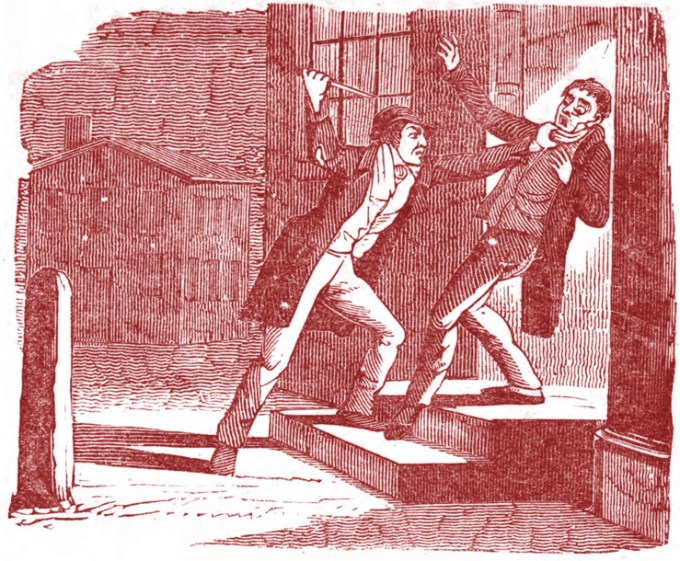
A “hurt and afraid” Claxton responded “[Expletive] Yes we are!” before pulling a clasp knife from his pocket with a blade “about the length of his finger,” and stabbed Parks in the chest. Parks died very shortly thereafter while Claxton made a hasty getaway. He was soon apprehended and taken to jail, charged with murder.

Tried on May 12, 1840, he was found guilty of the lesser charge of manslaughter, and sentenced to 5 years at hard labor in the State Penitentiary. He appealed to the Supreme Court of the state and was granted a hearing. Four days before Christmas they rendered their verdict: Even though the Judge made questionable remarks to the jury during his instructions, the high court ruled he had not actually committed an error. The verdict stood, and the same day Jim Claxton entered the prison on Church Street to start his five year sentence.

He didn’t make it. Like many another, he fell victim to the horrifying conditions within the hell hole that was “Old Red Top.” On March 18, 1844 he died of “marasmus,” or acute malnutrition. To put it another way, just three years into his sentence, the once robust young man had died of starvation.

In a sense, James Claxton and Moses Parks were both tragic nobodies, living and dying in the shadows of Jacksonian Nashville. But the their case serves as a peek into their squalid world, and allows us a more thorough view of the “have nots” as well as the “haves” of the city on the Cumberland in the 1840’s.

It’s also a lesson that not everything is out there on the net…sometimes ya just gotta dig.
All Around the Town

Nashville, like many cities, has a checkered relationship with its past. History often makes way for the new, and what remains is often hidden beneath layers of modern development. There are plenty of hidden slices of the past around the city, often in the most unusual locations. Every week, I’ll try to share some of the sites that this project has brought me in contact with.

First up, we have the Soldiers’ Rest Cemetery. This tiny plot is all that remains of the plantation of Gen. Thomas Overton (1753-1824), a veteran of the Revolutionary War. Overton served for  seven years with Washington’s army, originally in the 9th Virginia Regiment, and later with the 4th Continental Light Dragoons, seeing action at places like Germantown, Monmouth, and Yorktown, as well as wintering at Valley Forge. He moved to Tennessee around 1804, and founded a farm not far from that of Andrew Jackson. The two struck up a lifelong friendship. In fact, Overton later stood as Jackson’s second in his duel with Charles Dickinson in 1806.

The cemetery today stands in a small lot surrounded by houses and businesses near the intersection of Donelson Avenue and Old Hickory Boulevard. I visited it the day after Halloween, and was greeted by a coal black cat who followed me around the entire time, just…watching me. After thanking him, I doused myself and my car with holy water and took my leave.

This little plot once stood close to Overton’s mansion, appropriately named “Soldier’s Rest,” which was the centerpiece of his sprawling plantation. What brought me here? Well, in the fall of 1819 Overton’s place became the scene of a remarkable drama when his overseer was murdered by one of the slaves who worked on the farm. During the ensuing investigation, the slain overseer’s wife was accused of conspiring with the slave to kill her husband.

So what happened next?

Well, that’s why I want you to pick up a copy of the book when it comes out 🙂

For more information about Overton, here’s his page on the great oracle Wikipedia: https://en.wikipedia.org/wiki/Thomas_Overton

Greetings, and Welcome!

Hello, and welcome to my corner of the ‘net.

The purpose of this blog is to promote my upcoming book, “Murder and Mayhem in Nashville, Tennessee,” due to be published later this year. In these pages you will find some of the lesser known (some would say hidden) pieces of history that took place in the streets of Nashville, and the fields and hills surrounding it. I’ll be sharing interesting tidbits I’ve come across during my research that I think bear repeating.

If you’re from Nashville or not, if you’re new to the area or an “old timer” like me, or if you just like unusual stories about the past, come right in. You’re about to enter a world of gamblers, convicts, highwaymen, outlaws, bootleggers, and other colorful characters that once left their mark on the town. And if you have any comments or questions, send them along. I’d love to hear from you. All I ask is to keep it civil – we’re all here to learn.

So pull up a stump and make yourself comfortable. It should be a wild ride.

More to come. Stay tuned…