Upcoming Event

BTW, if you like the story about Jesse Bryan that I posted, you ought to come out to see the Nashville City Cemetery’s annual tour on October 15, from 3:00 to 7:00 PM, with the last tour leaving at 6.

Interpreters will be posted throughout the cemetery, portraying a selection of those interred there, and the theme this year revolves around some of the more tragic figures in the cemetery, as well as some of the…naughtier ones, shall we say? Should be a lively lineup.

And one of those on the roster is Mr. Bryan, who I’ve already blogged about, so you can hear the rest of his story – or at least his version of it 🙂  As an added bonus, you can come see me there as well – I’ll be on hand to sign my book and meet and greet, so come on out and see me after you enjoy the tour!

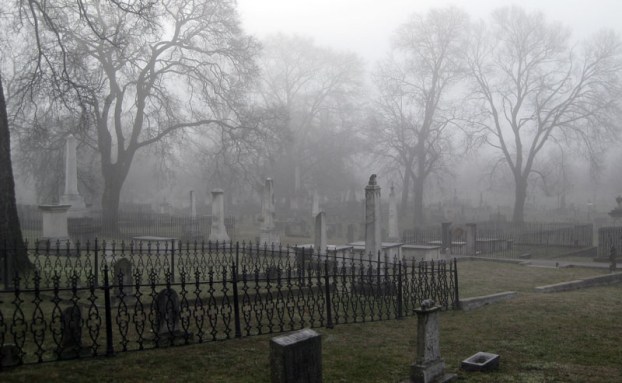
spooky-pic
Trust me, it really looks this spooky.

The Rest…Of the Story

…With apologies to Paul Harvey.

One of the frustrating things about writing a book is that often you find stuff about the subject only after it goes to press, and too late to insert into the manuscript. A prime example is the following tale, which only surfaced after the writing was done.

Jesse Avritt Bryan was born in 1815 and raised in Clarksville, Montgomery County. His father served in Congress but died when Jesse was only a youngster. He later became a partner with his brothers in a mercantile firm, and was quite popular – if touchy. “he was of a proud and sensitive nature,” one friend later wrote, but one that “could not brook aught of insult.” This sensitive nature got him into serious trouble in the summer of 1838 when he was 22.

Somehow he ran afoul of the starchy Marius Hansbrough, a 37-year old fellow Clarksvillian. Hansbrough was married, and his first and only child – a daughter – had been born earlier that year. He’d also apparently had a few hard knocks to deal with – in 1832 while he was attending a celebration of Washington’s birthday at Shelbyville, Kentucky, a cannon had exploded and his right arm had to be amputated from the resulting damage. In 1836 he had partnered up with G.A. Davie and purchased the Washington Hotel on the public square, the most prominent hotel in Clarksville. It would end up being a house he never left.

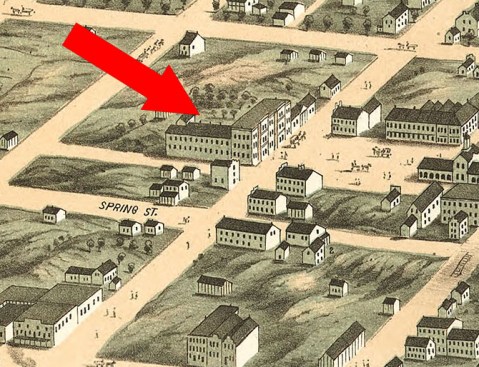
clarkpubsquare
The Washington Hotel, on the north side of the Clarksville Public Square, ca. 1870. It was originally a massive, three-story building constructed ca. 1825.


Exactly what their beef was is unclear, but one account says that Hansbrough had – correctly or not – interpreted some action on Bryan’s part as an insult. So angry was he that Bryan was later informed that Hansbrough had gone hunting for him with a bowie knife until his friends intervened. However, rather than meet with Bryan to settle the issue, he chose to shun the youngster and snub him. For over a year the two tiptoed around the ticking time bomb between them.

Finally, on August 4, 1838, Jesse Bryan walked into the Washington Hotel and met Marius Hansbrough face to face. He greeted the older man in a friendly fashion, but Hansbrough coldly told him that he wouldn’t associate with someone who was out to assassinate his character. An argument ensued which ended with Hansbrough threatening to “wring his nose” and “cut off his ears” if Bryan ever angered him again.

At that, Bryan stormed off and procured a bowie knife before heading out to find his adversary. On the sidewalk in front of Barksdale & Cromwell’s store they met and Bryan said he supposed Hansbrough was “prepared.” Almost immediately the fight began. Apparently Hansbrough raised his riding whip with his good left arm and tried to hit Bryan with it. Bryan slashed the upraised arm, but the cut did no damage as the sheath was still on the blade. He flung the sheath into the street and struck again, this time stabbing his target in the ribs on the left side.

Bryan fled while Hansbrough was carried back into his hotel and a doctor was summoned. Sadly, nothing could be done to stop the internal bleeding, and he lost ground rapidly. At 10:45 PM on Sunday, August 5th, Marius Hansbrough died.

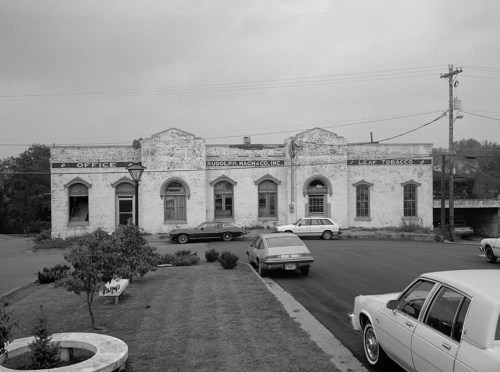
washington-hotel
Scene of the Crime: The Washington in its final days. Drastically cut down in the 20th century, it survived as a store and tobacco factory into the 1970’s. A parking lot occupies the site today.


Bryan was later apprehended and tried for the killing, but apparently he was acquitted on grounds of self-defense. However, this wasn’t the last scrape he would become involved in. His next fight would also involve a posh and popular hotel, this time on Nashville’s Public Square. And once more, it would be a duel to the death involving guns, knives, and a secret weapon. What happened?

You can find out in the pages of my book…

Now We’re Rolling…

I’m back after an unexpectedly long hiatus. My apologies. However, we’re just getting started.

The book at the heart of this whole brouhaha is coming soon (see the snazzy cover below). Street date is October 3rd, and I’m in the process of getting ready for a whole bunch of appearances and talks and signings in the upcoming weeks, so I hope to get to meet and talk to a bunch of you soon. So watch this space. More to come very soon.

Adobe Photoshop PDF

This time I promise 😉

P.S. – If you want to pre-order, you can do it here.


Finally, Milt Goes Down

NOTE: My apologies, this was supposed to be posted back in May with a short disclaimer saying that it would be a while till my next post. That being said, since it has been that while, let’s find out the end to that last saga, shall we?
inigo

Anyway, it’s 1881, and to catch everyone up to speed, Milt Yarberry, dangerously erratic gunman and constable of Albuquerque, NM Territory has just managed to blow away his romantic rival Harry Brown and get away with it. He continued in office for several weeks and managed not to kill anyone else until the afternoon of June 18, 1881.

On that evening, while Milt was talking with a  buddy on the porch of a house, someone fired a shot, probably in a fit of drunken high spirits. Yarberry rushed to the scene and asked who had done it, and when a bystander pointed out a man walking away, Milt unlimbered his .45 Colt and opened up, firing four shots. The man collapsed and witnesses said Milt rejoiced, saying, “I’ve downed the son of a b-—!”

A coroner’s jury established that the deceased, Charles D. Campbell (ironically a Tennessee native like Brown), had been hit by three shots in the chest and the back. Yarberry’s testimony was that Campbell, a railroad employee who was something of a drinker, had pulled a pistol and threatened him and that he had fired – as always in such cases – in self defense. However, the bullet hole in Campbell’s back raised eyebrows, despite Yarberry’s contention that Campbell had spun around when shot and taken the final bullet in that location. For the record, Campbell, though a drunk, had little reputation for violence and no pistol was found on the deceased, although admittedly it might have been removed by a rubbernecker at the scene.

Arrested and tried, Yarberry’s case divided the community of Albuquerque. He had both friends and enemies in the community, and the testimony at the trial was far from clear as to what had happened on that street in the dark. In the end the jury found Milt Yarberry guilty of murder in the first degree, and set his punishment as death by hanging.

Yarberry made an abortive escape attempt but was recaptured, an event that sealed his guilt in some minds. He resigned himself to his fate, playing his fiddle and bragging to the press from his jail cell. He eventually confided to his closest friend, Sheriff Perfecto Armijo, that his real name was Armstrong and that he was born in Arkansas.

On February 9, 1883 he was marched to the gallows – reportedly the same contraption whose construction he had overseen as constable. He made a speech from the platform, and made the cryptic statement that he was being hanged not for killing Campbell, but because he “killed a son of Governor Brown of Tennessee.” When the mask was drawn over his face, he made his final statement: “Gentlemen, you are hanging an innocent man!”

Innocent or not, the mechanism that sprung the trap was put into gear, and moments later  the man who lived as Milton J. Yarberry shot upwards and died. Today, he lies in Albuquerque’s Mount Calvary Cemetery. An impressive tombstone was placed at his head, paid for by his friends.

It was later stolen, and no trace of it exists today.
The Quick and the Dead

After his efforts to foil the robbery of the A.T. & S.F. at Kinsley, Harry Brown received the thanks of his company, and (along with Kinkaide) was hailed as the hero of the hour. He was even given an engraved Winchester rifle as a reward.

Fame seems to have gone to his head, and New Mexico newspapers report that he became an obnoxious braggart in the saloons up and down the line, acting like a goober and bragging of his exploits. He wouldn’t be the first Westerner to let his mouth run wild, but unlike a Bat Masterson or Wild Bill Hickok, his luck couldn’t keep up with his talk.

He was soon a fixture in Albuquerque, where he “hooked up” with a young woman named Sadie Preston. Unfortunately for him, she was already involved with a town constable who went by the unlikely name of Milton J. Yarberry.

Despite his rather goofy sobriquet, Yarberry had a wide reputation as a killer, and it was said he had already gunned down at least three men. Brown, with his own reputation, declared that he wasn’t afraid of Yarberry, who threatened to kill him several times. In retrospect, it seems that Yarberry was what Brown wanted to be – a stone-cold killer. Things came to a head on March 27, 1881.

Brown and Sadie Preston were eating at Girard’s restaurant, while – unbelievably – Yarberry babysat for her, watching her four-year old daughter. The constable soon appeared at the restaurant and led the little girl to her mother, while he and Brown stepped outside to talk.

According to an “ear witness” (a hack driver who had his back to the scene) Brown and Yarberry had a heated discussion, at the conclusion of which Brown stated, “Milt, I want you to understand I am not afraid of you and would not be even if you were Marshal of the United States!” Almost immediately there were gunshots. The hackman turned just in time to see Brown stagger backwards with two bullets in his chest. As he collapsed, Yarberry fired two more into him as he lay on the sidewalk.

Yarberry’s claim was the traditional one – self-defense. He claimed that Brown had been twitchy, trying to get “the drop” on him. When that didn’t work, he said that Brown had slapped him in the face and gone for his gun, and he’d beaten him to the draw. If true, Milt must have been some sort of wizard with a six-gun – witnesses later said that Brown’s pistol was still snugly in its holster when he was carried away. A report in the Nashville press that he had raised up after being shot and stated, “You have murdered me in a cowardly way!” seems unlikely – it looks like Brown was too badly hurt to say anything.

All four of Yarberry’s bullets passed through his body, and he died a short time later. A terse telegram, stating only that “Harry was killed yesterday at 7 o’clock,” was sent to former governor Brown in Nashville, and the young man’s remains were shipped home via Santa Fe and Kansas City. On April 4th, he was buried at Mount Olivet Cemetery, his former friends in the Porter Rifles providing an honor guard for the funeral procession. The grief-stricken father would outlive his son by five years.

Tried for murder, Yarberry was later acquitted. He had many friends who celebrated – but many others in Albuquerque also condemned him as a murderer. Nevertheless, he continued in office as a town constable…at least for the time being.

Next time…the bizarre end of the story of the trigger-happy lawman.

Once Upon a Time in the West

Under a quiet headstone in Mount Olivet Cemetery today rests an honest-to-goodness reminder of the “Wild Wild West” (the real one, not the Will Smith movie). Several western characters passed through Nashville at one time or another, but one of the town’s homegrown gunfighters was actually from a respectable family.

Henry A. Brown was the son of former Whig governor Neill S. Brown, and the nephew of Democrat (and former Confederate general) John Calvin Brown. He lies near his father in the family plot under a headstone that simply bears his name, birth, and death dates. It gives no hint ofthe adventurous life he led.

Born in 1854 at “Idlewild,” his father’s house near Nashville, young Harry grew up during the tumult of the Civil War, during which his father stuck by his guns as one of the most prominent Unionists in town. Following Appomattox he received a good education before turning his sights to the West. In the spring of 1876, the 22-year old Brown joined an exploratory expedition sponsored by Vanderbilt University. He was, said a school chum, “attracted by the promise of the Great West, and…of an adventurous spirit…”

After some time he found employment with the Adams Express Company, one of the nation’s biggest railroad shipping firms, and signed on as an “Express Messenger” – which was a polite way of saying “shotgun guard.” His duty was to protect the property put in charge of the company from bandits and other hazards of the road. This soon put him in close (and uncomfortable) contact with some of the legendary figures of the era.

On the evening January 27, 1878, Brown was aboard an Atchison, Topeka, and Santa Fe train approaching the whistle stop of Kinsley, Kansas. He had a big parcel to deliver at this stop, and as the car shuddered to a halt, he pushed the door open, holding a lantern and idly wondering how to shove the thing onto the platform.

Unknown to him, some drama had been playing out at the station before the train arrived. Six heavily armed gunmen had held up the night man, Andrew Kinkaide, in preparation for robbing the train. Kinkaide broke away just as the train entered the station and despite being shot at, began to scream the alarm. The startled engineer actually missed the stop and managed to bring the train to a halt several hundred yards past the station. Kinkaide’s quick thinking warned the town, the conductor, and the engineer. However, Brown was isolated in his car and didn’t get the message.

When the door on the car swung open, Brown must have been surprised to see no station – just open prairie and six masked men pointing revolvers at him, ordering him to “shell out.” He stared back at them – and then got busy justifying his salary.

Without hesitation Brown threw his lantern into their faces, startling them and darkening the car. He then grabbed his rifle and opened fire. The bandits shot back and for several seconds there was a lively exchange until the engineer managed to get the train out of range. Nobody was hit on either side, and the outlaws eventually gave it up as a bad business and left empty-handed.

Within hours, posses were on the trail, headed by the legendary sheriff of Ford County, Bartholomew “Bat” Masterson – who was technically out of his jurisdiction. However, with his customary energy Masterson quickly rounded up two of the gangsters. Ed West was a nobody but his partner Dave Rudabaugh was destined for minor fame. At trial, Rudabaugh turned on his partners-in-crime and testified against them in exchange for his freedom. Later, “Dirty Dave” joined Billy the Kid’s gang in New Mexico and was supposedly beheaded at Parral in Mexico in 1886 after seriously ticking off the local rowdies. Christian Slater later played him in the movies.

And as for Harry Brown? Tune in next time for the conclusion of his action-packed story.


A Duel in the Sun

From the time it was founded in 1796, Tennessee’s legal code forbade the gentlemanly “art” of dueling. This is why so many famous duels in the state’s history (Jackson-Dickinson, Coffee-McNairy) were started in Nashville and finished elsewhere. The favored dueling ground was the strip of land in Adair County, KY, just across the state line.

However, not so in every case. Early Nashville did see its share of formal duels – usually when two gentlemen were so peeved at each other they decided they couldn’t wait for “satisfaction” and risked the consequences under the law.

The first known fatal duel to take place in the city occurred at sunrise on March 18, 1800. As is so often the case the cause is lost to history. All that is known is that two doctors had a falling out for some reason or other, enough so that Dr. Francis May challenged Dr. Frank Brown Sappington to meet him with pistols  in a cedar thicket just south of town (guesstimation puts the spot at approximately where the Music City Center now stands).

Before dawn on the day of the duel, Sappington composed a poignant letter to his brother explaining his actions. It remains a rare look into the mind of a duelist:

                                                                                                                                                Nashville, 18th March 1800.

Dr. Roger,

                Ere the Sun Arrives at its Maridean [sic] height to day my Existance [sic] in this World may be Terminated I am Engaged In a Disagreeable Business and Which you are and Always must be a Stranger To, Circumstances, Prevents one from Detailling [sic] this to you, however you may be Assured it is with Reluctance I am Draged [sic] into this Affair, And Nothing but Defending my Reputation, Which no man Shall Assail, with Impunity, Could Induce me to it — My Worldly Affairs I Commit in your Charge Should my Death be the Consequence of this Act, After the Settlement of all Demands Against the firm of A. Foster & Co. I am Intitled [sic] to one third the Profits of said house which I Wish my Father you and my own Brothers and Sisters to Enjoy Refering [sic] you however to my Letter of this Date to William Lytle my ever Dear friend and Assistant in this Affair — It gives me the Greatest Satisfaction even [in] this trying moment to think I have Never Intentionally and Knowingly Stained the Reputation of my self and Relations – Which I hope and Trust no Person Can Justly Asperse, May heaven Continue This Blessing to you all unimpaired is the Prayer of your Sincere Brother

                                                                                                                                                Francis B. Sappington

This letter he tucked into his pocketbook before setting out for the field. The combatants met at dawn and one fire was exchanged. Sappington’s shot missed; May’s struck his opponent in the forehead inflicting a wound “of the depth of four inches and of the breadth of one fourth of an inch.” He died instantly.

Indicted for murder, May immediately lit out for the town of Knoxville where he was given shelter by friends. Indeed, he was able to practice medicine openly without fear of arrest and even married Polly, the daughter of Knoxville’s founder Gen. James White. In May of 1802 he returned to Nashville where he stood trial for murder. To nobody’s surprise, he was found not guilty – gentlemen rarely convicted other gentlemen of behaving like gentlemen.

May went on to act as a surgeon during an even more famous duel four years later involving this guy.


Blatant Self-Promotion

As the title says…why have a blog if you can’t exploit it? As Pappy McDan’l says: “We’re mass communicatin’!”

Anyway, this has little to do with the subject at hand, but if you’re looking for a cool thing to do in a couple of weeks, why not come out and attend my workshop that teaches you how to cut and write with a quill pen? I can’t teach you how to write the same way as Lucretia Borgia, Thomas Jefferson, or Harry Potter, but I can teach you how to make the same tools they used Click here to see the literature:Pen in Hand Flyer2

No experience necessary, and a modest fee is charged. The workshop is at Rock Castle in Hendersonville on April 23, 2016 from 10 AM to Noon (or whenever you get bored). Click on this link to find out more or to register.(And if you’ve never been to Rock Castle you should check it out. It’s a fantastic site.)

And if you have questions about this blog, the book, or anything else, feel free to say hi.

Those Yagers…

As always with this blog…one subject often leads to another in surprising ways.Yager 2

The mention of the “German Yagers” in the article about Lt. Chandler’s reburial also spawned some interesting additional info. The company, as the name suggests, was a militia company made up of mostly German immigrants living in Nashville (Jaeger is German for “hunter” and indicates light infantry or riflemen). Forty-seven strong originally, the unit was formed in 1858 and often appeared with the socially-prominent men of the “Rock City Guards” on public occasions – such as the time in 1859 when the two companies hosted the “Chatham Light Artillery” of Savannah who came on a visit to Nashville. The units attended balls and social functions, and even laid a wreath at Andrew Jackson’s grave at the Hermitage. And one suspects, the Chatham boys treated their hosts to their famous punch and left everyone with glorious hangovers.

The Yagers had a reputation for military smartness, and the uniform they wore was super snazzy: a dark green frock coat with light green collar and cuffs, piped on the edges in red. Trousers were light gray with a green stripe up the side seams, and (true to their name) they carried rifles with “short swords” (probably the “Mississippi” rifle and its sword-bayonet.) The headgear was described as the same as that worn by the “U.S. Riflemen” – presumably the regulation “Hardee” hat worn by the Regiment of Mounted Rifles. The sketch (right) shows their probable appearance.

The company was given an upstairs room in the Market House on Public Square as their meeting place, and were presented a flag by the German ladies of Nashville. Despite their vow to avoid “politics,” that was not to be. In 1861 they volunteered to go off to fight for the new Confederate government and expanded to a full 100-man company. Changing their name to the “Tennessee Riflemen” (probably to appeal to non-German recruits), the unit became Company E of the  1st Tennessee Infantry. Very few of them returned at the end of the war.


The Big House

TenPen
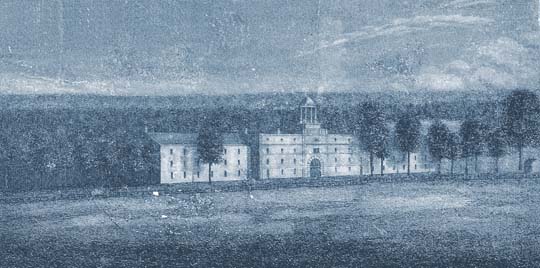
“Old Red Top,” as it appeared around the time it opened in 1831. Beyond the central gate and the two wings of cellblocks was a courtyard where the prison shops were located

Tennessee’s first prison was opened just after New Year’s, 1831.

Inspired by the “Pennsylvania system” pioneered at Eastern State Penitentiary, it was intended for reform as much as punishment. In theory the prisoners would work at a trade and use their off hours to reflect on the magnitude of their transgressions. In fact, it didn’t take long before the place disintegrated into chaos, and from the beginning it was plagued by disease, violence, abuse, and filthy living conditions.

The original building was intended to house 200 prisoners, but it was soon found necessary to expand to keep up with a growing population. The “Jail and Penitentiary House of the State” was perpetually overcrowded, adding to the general misery within.

Originally it was situated outside the city limits, but by the middle of the 19th century the town had grown past it, and the location became part of Church Street. The north wall of the complex ran along modern-day 16th Ave. South (known originally as “Stonewall Street”). The red tile roof became an uncomfortably familiar sight to inmates, who soon nicknamed the place “Old Red Top” – a name that would later be transferred to the “new” State Prison built in 1898 (known today as “the Castle“).

And, as with all human endeavor, someone had to be first.

Tucked away in the prison records is the name of a pioneer – the very first man ever incarcerated in prison in the State of Tennessee. His name was George Washington Cook, and he entered the joint on January 21, 1831.

Cook was born in Kentucky  in 1810 and raised near Nashville before moving to Madison County during the land rush following the eviction of the Chickasaws from their native land in the “Jackson Purchase” of 1818. There, he followed the tailor’s trade.

He was convicted of “malicious stabbing” in the county circuit court, and sentenced to 2 years in prison. On entry into the new facility, the clerk noted for posterity that he was “six feet high, light hair, blue eyes, fair skin,” and had “a scar on his left thumb an inch long.” He did his time quietly and was released on schedule on Jan. 21, 1833. The clerk noted his conduct as “very good.”

Afterwards, he faded back into the shadows of history – one hopes with a better handle on his temper in the years to come.