A Duel in the Sun

From the time it was founded in 1796, Tennessee’s legal code forbade the gentlemanly “art” of dueling. This is why so many famous duels in the state’s history (Jackson-Dickinson, Coffee-McNairy) were started in Nashville and finished elsewhere. The favored dueling ground was the strip of land in Adair County, KY, just across the state line.

However, not so in every case. Early Nashville did see its share of formal duels – usually when two gentlemen were so peeved at each other they decided they couldn’t wait for “satisfaction” and risked the consequences under the law.

The first known fatal duel to take place in the city occurred at sunrise on March 18, 1800. As is so often the case the cause is lost to history. All that is known is that two doctors had a falling out for some reason or other, enough so that Dr. Francis May challenged Dr. Frank Brown Sappington to meet him with pistols  in a cedar thicket just south of town (guesstimation puts the spot at approximately where the Music City Center now stands).

Before dawn on the day of the duel, Sappington composed a poignant letter to his brother explaining his actions. It remains a rare look into the mind of a duelist:

                                                                                                                                                Nashville, 18th March 1800.

Dr. Roger,

                Ere the Sun Arrives at its Maridean [sic] height to day my Existance [sic] in this World may be Terminated I am Engaged In a Disagreeable Business and Which you are and Always must be a Stranger To, Circumstances, Prevents one from Detailling [sic] this to you, however you may be Assured it is with Reluctance I am Draged [sic] into this Affair, And Nothing but Defending my Reputation, Which no man Shall Assail, with Impunity, Could Induce me to it — My Worldly Affairs I Commit in your Charge Should my Death be the Consequence of this Act, After the Settlement of all Demands Against the firm of A. Foster & Co. I am Intitled [sic] to one third the Profits of said house which I Wish my Father you and my own Brothers and Sisters to Enjoy Refering [sic] you however to my Letter of this Date to William Lytle my ever Dear friend and Assistant in this Affair — It gives me the Greatest Satisfaction even [in] this trying moment to think I have Never Intentionally and Knowingly Stained the Reputation of my self and Relations – Which I hope and Trust no Person Can Justly Asperse, May heaven Continue This Blessing to you all unimpaired is the Prayer of your Sincere Brother

                                                                                                                                                Francis B. Sappington

This letter he tucked into his pocketbook before setting out for the field. The combatants met at dawn and one fire was exchanged. Sappington’s shot missed; May’s struck his opponent in the forehead inflicting a wound “of the depth of four inches and of the breadth of one fourth of an inch.” He died instantly.

Indicted for murder, May immediately lit out for the town of Knoxville where he was given shelter by friends. Indeed, he was able to practice medicine openly without fear of arrest and even married Polly, the daughter of Knoxville’s founder Gen. James White. In May of 1802 he returned to Nashville where he stood trial for murder. To nobody’s surprise, he was found not guilty – gentlemen rarely convicted other gentlemen of behaving like gentlemen.

May went on to act as a surgeon during an even more famous duel four years later involving this guy.

 

Blatant Self-Promotion

As the title says…why have a blog if you can’t exploit it? As Pappy McDan’l says: “We’re mass communicatin’!”

Anyway, this has little to do with the subject at hand, but if you’re looking for a cool thing to do in a couple of weeks, why not come out and attend my workshop that teaches you how to cut and write with a quill pen? I can’t teach you how to write the same way as Lucretia Borgia, Thomas Jefferson, or Harry Potter, but I can teach you how to make the same tools they used Click here to see the literature:Pen in Hand Flyer2

No experience necessary, and a modest fee is charged. The workshop is at Rock Castle in Hendersonville on April 23, 2016 from 10 AM to Noon (or whenever you get bored). Click on this link to find out more or to register.(And if you’ve never been to Rock Castle you should check it out. It’s a fantastic site.)

And if you have questions about this blog, the book, or anything else, feel free to say hi.

Those Yagers…

As always with this blog…one subject often leads to another in surprising ways.Yager 2

The mention of the “German Yagers” in the article about Lt. Chandler’s reburial also spawned some interesting additional info. The company, as the name suggests, was a militia company made up of mostly German immigrants living in Nashville (Jaeger is German for “hunter” and indicates light infantry or riflemen). Forty-seven strong originally, the unit was formed in 1858 and often appeared with the socially-prominent men of the “Rock City Guards” on public occasions – such as the time in 1859 when the two companies hosted the “Chatham Light Artillery” of Savannah who came on a visit to Nashville. The units attended balls and social functions, and even laid a wreath at Andrew Jackson’s grave at the Hermitage. And one suspects, the Chatham boys treated their hosts to their famous punch and left everyone with glorious hangovers.

The Yagers had a reputation for military smartness, and the uniform they wore was super snazzy: a dark green frock coat with light green collar and cuffs, piped on the edges in red. Trousers were light gray with a green stripe up the side seams, and (true to their name) they carried rifles with “short swords” (probably the “Mississippi” rifle and its sword-bayonet.) The headgear was described as the same as that worn by the “U.S. Riflemen” – presumably the regulation “Hardee” hat worn by the Regiment of Mounted Rifles. The sketch (right) shows their probable appearance.

The company was given an upstairs room in the Market House on Public Square as their meeting place, and were presented a flag by the German ladies of Nashville. Despite their vow to avoid “politics,” that was not to be. In 1861 they volunteered to go off to fight for the new Confederate government and expanded to a full 100-man company. Changing their name to the “Tennessee Riflemen” (probably to appeal to non-German recruits), the unit became Company E of the  1st Tennessee Infantry. Very few of them returned at the end of the war.


The Big House

TenPen
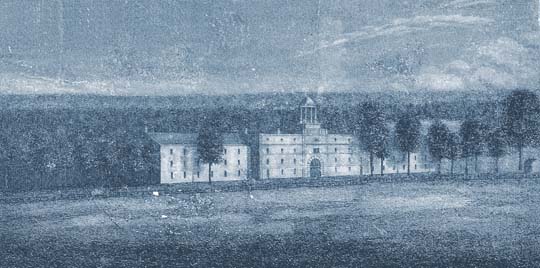
“Old Red Top,” as it appeared around the time it opened in 1831. Beyond the central gate and the two wings of cellblocks was a courtyard where the prison shops were located

Tennessee’s first prison was opened just after New Year’s, 1831.

Inspired by the “Pennsylvania system” pioneered at Eastern State Penitentiary, it was intended for reform as much as punishment. In theory the prisoners would work at a trade and use their off hours to reflect on the magnitude of their transgressions. In fact, it didn’t take long before the place disintegrated into chaos, and from the beginning it was plagued by disease, violence, abuse, and filthy living conditions.

The original building was intended to house 200 prisoners, but it was soon found necessary to expand to keep up with a growing population. The “Jail and Penitentiary House of the State” was perpetually overcrowded, adding to the general misery within.

Originally it was situated outside the city limits, but by the middle of the 19th century the town had grown past it, and the location became part of Church Street. The north wall of the complex ran along modern-day 16th Ave. South (known originally as “Stonewall Street”). The red tile roof became an uncomfortably familiar sight to inmates, who soon nicknamed the place “Old Red Top” – a name that would later be transferred to the “new” State Prison built in 1898 (known today as “the Castle“).

And, as with all human endeavor, someone had to be first.

Tucked away in the prison records is the name of a pioneer – the very first man ever incarcerated in prison in the State of Tennessee. His name was George Washington Cook, and he entered the joint on January 21, 1831.

Cook was born in Kentucky  in 1810 and raised near Nashville before moving to Madison County during the land rush following the eviction of the Chickasaws from their native land in the “Jackson Purchase” of 1818. There, he followed the tailor’s trade.

He was convicted of “malicious stabbing” in the county circuit court, and sentenced to 2 years in prison. On entry into the new facility, the clerk noted for posterity that he was “six feet high, light hair, blue eyes, fair skin,” and had “a scar on his left thumb an inch long.” He did his time quietly and was released on schedule on Jan. 21, 1833. The clerk noted his conduct as “very good.”

Afterwards, he faded back into the shadows of history – one hopes with a better handle on his temper in the years to come.