According to an old timer, Chandler’s was the first grave at the Sulphur Spring, in an isolated grove on land deemed unsuitable for farming. Chandler had come into town in poor health from an outpost (possibly Fort Southwest Point) and died at Talbot’s Tavern on Public Square. His burial took place on a snowy day in late December, 1801, with a small contingent of citizens and army officers in attendance. They hoped that it would prove a suitable location for his final resting place. They were wrong.
By 1859, the vicinity around the grave of Lt. Chandler had become – to put it mildly – an eyesore. The once genteel public park had become the hangout of “disreputable” sorts, a popular trysting point for adventurous couples. It was apparently some of these ne’er-do-wells who had vandalized the old grave in the first place, breaking two feet of the slab off the stone lid.
Due to the deteriorating condition of the area, a motion was forwarded to the City Council by the Tennessee Historical Society to reinter the lieutenant’s remains in Mount Olivet Cemetery in a more fitting manner. September 23rd was named as moving day.
It was quite a to-do. Major Adolphus Heiman, the noted architect, was named as the Marshal of the ceremony, and Edward East of the City Council was named speaker. The cadets from the University of Nashville Military Academy were invited, but apparently declined. However, the “German Yagers” (sic – Jägers) probably a light infantry militia company from Germantown, provided an escort. The body was exhumed at around 9 A.M.
To everyone’s surprise, despite the frequent floods that had washed over the crypt, the skeleton was intact, and the papers noted that badly-healed breaks in the right arm and leg showed that the lieutenant had “passed through some rough scenes” during his service. The bones were placed in a velvet-lined casket with thirteen silver stars on it.
At 2:00 P.M. the remains were escorted from Public Square to McKendree Church where the funeral service was read by Rev. Charles T. Quintard (soon to be noted as a leading Confederate chaplain). From there it was on to Mount Olivet, the body escorted by veterans of 1812, the Seminole War, and the Mexican War. September 23 was the anniversary of the Battle of Monterey, Mexico, making it doubly meaningful for the old soldiers.
Chandler was buried beneath a tree on a high hill in the new cemetery, to the accompaniment of a twenty-one gun salute fired by the “Yagers.” The old stone sarcophagus was too far gone to save, but the plans were to put an appropriate new marker over his grave.
And then the Civil War happened. And apparently all that was forgotten.
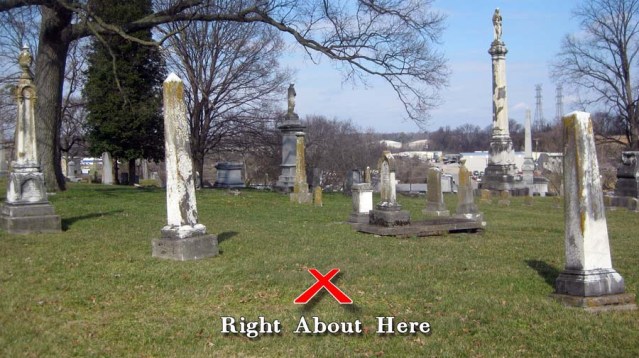
Today, Chandler remains unmarked, more than 150 years after his second funeral. I made a search recently for him, and the records indicate that he’s buried in Plot No. 118, Section No. 1. The problem is…there is no 118.
The numbered plots seem to end with 117. As far as anyone can tell, this earliest of Nashville burials lies today in an unmarked grave, probably next to the old sunken “Hearse Road” that runs through Section 1. The photo below shows the approximate spot.
Perhaps one day his resting place can be confirmed and a suitable marker placed above his grave. But for right now, one of Nashville’s links to its frontier past lies forgotten, surrounded by elegant Victorian markers from a more “settled” time.
More to come next time.
 nashvillemayhemdotcom