ANNND, we’re back. Sorry ’bout that. I’ll try not to be away that long again.
Our next tale involves neither murder nor mayhem, but an interesting tale about a grave that was lost…then found…then lost once more. And therein lies some information on Nashville’s earliest graveyard and its current rebirth into…something else.
Five days before Christmas in 1801, a soldier died in Nashville. Lieutenant Richard Chandler was the paymaster of the 4th U.S. Infantry, and a veteran of the many wars fought in the “Northwest Territory” (modern-day Ohio). Originally from Virginia, he was commissioned an Ensign in the 4th Sub-Legion on May 12, 1794, and in August of that year he fought with “Mad Anthony” Wayne at the bloody Battle of Fallen Timbers. He was made paymaster on July 22, 1795. When the 4th Sub-Legion was re-designated the 4th Infantry on Nov. 1, 1796, Chandler went with it. He was promoted to 1st Lieutenant on July 31, 1798, still acting as paymaster. During this period, he did outpost duty with his command, manning far-flung posts in Tennessee and Georgia.
After Chandler’s untimely death he was interred in an impressive stone-box tomb in the town’s burying ground, which at that time was along the banks of the now-vanished Lick Branch near the Sulphur Spring. This ad-hoc cemetery grew rapidly after the first settlers began to die under the musket balls and tomahawks of the Chickasaw, Cherokee, and Creek warriors of the 1780s.
In 1822 the new City Cemetery was founded, and the old one fell out of fashion. Gradually it fell into decay as the Sulphur Spring was reinvented as the town’s new pleasure gardens. If the original graves weren’t relocated into the new cemetery, they were gradually overgrown and forgotten.
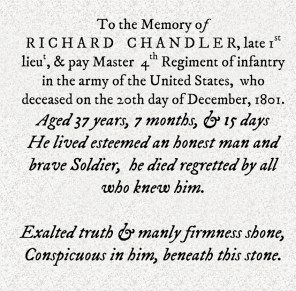
Chandler was lucky. Just as the Civil War was looming on the horizon a new interest in the early pioneers manifested itself, and a movement developed to preserve some of the relics of that age. On July 7, 1859 several sketches were made of the old burial. The worn epitaph was recorded thusly:
The location of the tomb was also sketched:
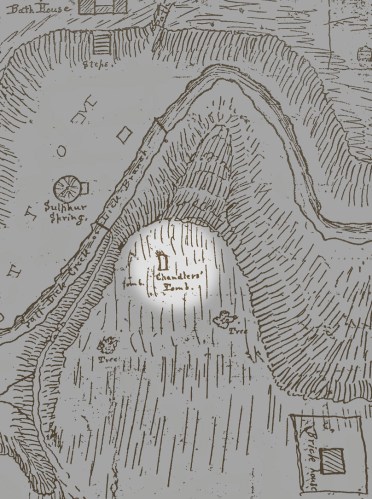
It’s a remarkable snapshot of a long vanished Nashville staple – up until the Civil War and after “the Springs” were where folks of all walks of life went to pass time, and to be seen and see. Long before baseball settled there in the late 19th century, it was Nashville’s first public park. The tomb stood across the branch from the Springhouse itself, on a tall spit of land at the end of Cherry Street (now 4th Ave.)
The sketch is not to scale, but by comparison with other maps done about the same time (the Army was very interested in correct cartography during the Late Unpleasantness), it is possible to come close. The location appears to be somewhere in the parking lot of the new First Tennessee Park baseball stadium.
Needless to say, there is little left to remind one of the spot’s 19th century appearance today, but the next time you attend a game there, hopefully you can have a new appreciation for the history of the spot as you trudge wearily towards your car under a hot summer sun.
As to Chandler, what happened to him? In 1859 a “memorial” was given to City Council, proposing to move the grave “to either the City Cemetery or to Mt. Olivet…”
More on that next time.
 nashvillemayhemdotcom