It’s A Beautiful Day in the Neighborhood…

As a follow up, here’s a quaint item illustrating exactly how fragrant the vicinity of Lt. Chandler’s penultimate resting place had become by the time they moved the tomb:

“Cephus McStravick, evidently a sporting gentleman, fond of fire arms, was arrested for indulging his ruling passion in unlawful, not to say exceedingly dangerous manner. It appears that Cephus was passing through the jungles in the neighborhood of the Sulphur Spring, when his eye rested upon a woman standing at a second story window of one of the houses in that locality. Cephus expressed himself to the effect that she offered a good mark for his pistol, which he drew. The woman dodged, but defendant fired, and his ball passed through an adjoining window and into an apartment which was fortunately tenantless at that moment. The Court regarded the offence as a flagrant one, and inflicted the highest penalty in its power, $50 and costs.”

[“Police Court,” Nashville, TN Republican Banner, Apr. 23, 1857.]

So…a gambler uses a woman at a brothel window for target practice. Just another fine day in the “jungles.”

And also…”Cephus McStravick?” Really?

Tune in next time…

Old Soldiers Fade Away – Part 2

According to an old timer, Chandler’s was the first grave at the Sulphur Spring, in an isolated grove on land deemed unsuitable for farming. Chandler had come into town in poor health from an outpost (possibly Fort Southwest Point) and died at Talbot’s Tavern on Public Square. His burial took place on a snowy day in late December, 1801, with a small contingent of citizens and army officers in attendance. They hoped that it would prove a suitable location for his final resting place. They were wrong.

By 1859, the vicinity around the grave of Lt. Chandler had become – to put it mildly – an eyesore. The once genteel public park had become the hangout of “disreputable” sorts, a popular trysting point for adventurous couples. It was apparently some of these ne’er-do-wells who had vandalized the old grave in the first place, breaking two feet of the slab off the stone lid.

Due to the deteriorating condition of the area, a motion was forwarded to the City Council by the Tennessee Historical Society to reinter the lieutenant’s remains in Mount Olivet Cemetery in a more fitting manner. September 23rd was named as moving day.

It was quite a to-do. Major Adolphus Heiman, the noted architect, was named as the Marshal of the ceremony, and Edward East of the City Council was named speaker. The cadets from the University of Nashville Military Academy were invited, but apparently declined. However, the “German Yagers” (sic – Jägers) probably a light infantry militia  company from Germantown, provided an escort. The body was exhumed at around 9 A.M.

To everyone’s surprise, despite the frequent floods that had washed over the crypt, the skeleton was intact, and the papers noted that badly-healed breaks in the right arm and leg showed that the lieutenant had “passed through some rough scenes” during his service. The bones were placed in a velvet-lined casket with thirteen silver stars on it.

At 2:00 P.M. the remains were escorted from Public Square to McKendree Church where the funeral service was read by Rev. Charles T. Quintard (soon to be noted as a leading Confederate chaplain). From there it was on to Mount Olivet, the body escorted by veterans of 1812, the Seminole War, and the Mexican War. September 23 was the anniversary of the Battle of Monterey, Mexico, making it doubly meaningful for the old soldiers.

Chandler was buried beneath a tree on a high hill in the new cemetery, to the accompaniment of a twenty-one gun salute fired by the “Yagers.” The old stone sarcophagus was too far gone to save, but the plans were to put an appropriate new marker over his grave.

And then the Civil War happened. And apparently all that was forgotten.

Today, Chandler remains unmarked, more than 150 years after his second funeral. I made a search recently for him, and the records indicate that he’s buried in Plot No. 118, Section No. 1. The problem is…there is no 118.

The numbered plots seem to end with 117. As far as anyone can tell, this earliest of Nashville burials lies today in an unmarked grave, probably next to the old sunken “Hearse Road” that runs through Section 1. The photo below shows the approximate spot.
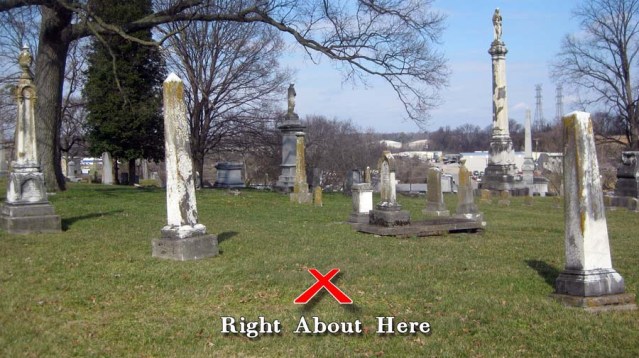
Chandler

Perhaps one day his resting place can be confirmed and a suitable marker placed above his grave. But for right now, one of Nashville’s links to its frontier past lies forgotten, surrounded by elegant Victorian markers from a more “settled” time.

More to come next time.
 

Old Soldiers Fade Away – Part 1

ANNND, we’re back. Sorry ’bout that. I’ll try not to be away that long again.

Our next tale involves neither murder nor mayhem, but an interesting tale about a grave that was lost…then found…then lost once more. And therein lies some information on Nashville’s earliest graveyard and its current rebirth into…something else.

Five days before Christmas in 1801, a soldier died in Nashville. Lieutenant Richard Chandler was the paymaster of the 4th U.S. Infantry, and a veteran of the many wars fought in the “Northwest Territory” (modern-day Ohio). Originally from Virginia, he was commissioned an Ensign in the 4th Sub-Legion on May 12, 1794, and in August of that year he fought with “Mad Anthony” Wayne at the bloody Battle of Fallen Timbers. He was made paymaster on July 22, 1795.  When the 4th Sub-Legion was re-designated the 4th Infantry on Nov. 1, 1796, Chandler went with it. He was promoted to 1st Lieutenant on July 31, 1798, still acting as paymaster. During this period, he did outpost duty with his command, manning far-flung posts in Tennessee and Georgia.

After Chandler’s untimely death he was interred in an impressive stone-box tomb in the town’s burying ground, which at that time was along the banks of the now-vanished Lick Branch near the Sulphur Spring. This ad-hoc cemetery grew rapidly after the first settlers began to die under the musket balls and tomahawks of the Chickasaw, Cherokee, and Creek warriors of the 1780s.

In 1822 the new City Cemetery was founded, and the old one fell out of fashion. Gradually it fell into decay as the Sulphur Spring was reinvented as the town’s new pleasure gardens. If the original graves weren’t relocated into the new cemetery, they were gradually overgrown and forgotten.

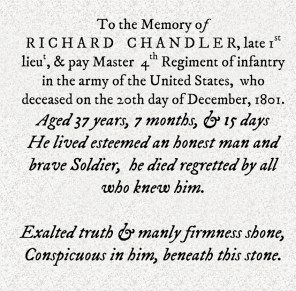
Chandler was lucky. Just as the Civil War was looming on the horizon a new interest in the early pioneers manifested itself, and a movement developed to preserve some of the relics of that age. On July 7, 1859 several sketches were made of the old burial. The worn epitaph was recorded thusly:

Chandler Inscription


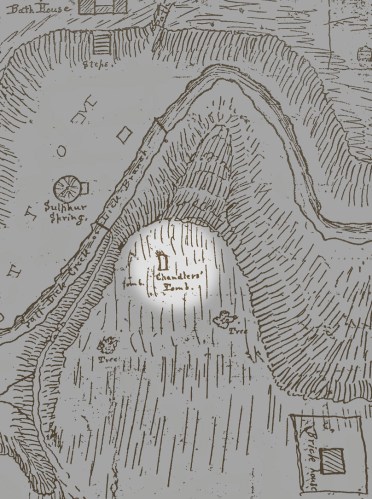
The location of the tomb was also sketched:

Chandler's Tomb

It’s a remarkable snapshot of a long vanished Nashville staple – up until the Civil War and after “the Springs” were where folks of all walks of life went to pass time, and to be seen and see. Long before baseball settled there in the late 19th century, it was Nashville’s first public park. The tomb stood across the branch from the Springhouse itself, on a tall spit of land  at the end of Cherry Street (now 4th Ave.)

The sketch is not to scale, but by comparison with other maps done about the same time (the Army was very interested in correct cartography during the Late Unpleasantness), it is possible to come close. The location appears to be somewhere in the parking lot of the new First Tennessee Park baseball stadium.

Needless to say, there is little left to remind one of the spot’s 19th century appearance today, but the next time you attend a game there, hopefully you can have a new appreciation for the history of the spot as you trudge wearily towards your car under a hot summer sun.

As to Chandler, what happened to him? In 1859 a “memorial” was given to City Council, proposing to move the grave “to either the City Cemetery or to Mt. Olivet…”

More on that next time.


Back In the Saddle…


Posse

For those who have stopped by recently and noticed a lack of activity…you’re right. My apologies. That’s about to change.

It’s been Deadline Time ™ around these parts and that’s taken up all my energy the past few weeks. The good news is that as of this afternoon the manuscript that lies behind this blog is officially submitted! It’s now winging its way to my editor, so that she can start carving it into a book.

That means I can get back to posting some cool stuff here, so if you’re looking for your daily dose of interesting historical facts, stay tuned. We should be back on track by Monday.

Watch this space…