One of the interesting things about research is that you never know where the sources will take you.
The Nashville Union gave the following brief notice in its April 9, 1840 issue: “MURDER: James Claxton stabbed a man by the name of Moses Parks at a house of ill fame in this city on Tuesday. Parks died immediately, and Claxton made his escape.”
The New Orleans Times-Picayune shed little additional light on the case, except to take a shot at the character of both men: “They were both loafers.”
For a long time these two brief articles were all I could find on the incident. However, a little searching in the Tennessee State Penitentiary Records and the Circuit Court Minutes at the Tennessee State Library filled in the blanks. What the sources reveal provides an unusually rich slice of the world of gamblers, ladies of the evening, and – yes – “loafers” who could be found in the back alleys of pre-Civil War Nashville.
Jim Claxton was 21 at the time, born and raised in Nashville. 5’9 1/2″ tall, 167 lbs. with black hair, hazel eyes and a dark complexion, he had first been a horse jockey, “until too large.” Thereafter he “followed the River,” working as a deckhand and fireman aboard the many boats plying the Cumberland. He also seems to have been a rough customer, with scars on the left cheek, left leg, and left arm, and had at one point been “Shot in the left arm & leg.” Intriguingly, his mother is said to have kept “a house of ill-fame” on “Vinegar Hill” in Nashville (on the bank of the Cumberland, near the present-day intersection of Adams and Van Buren Streets.) Whether her establishment was the one where the fight happened is not mentioned.
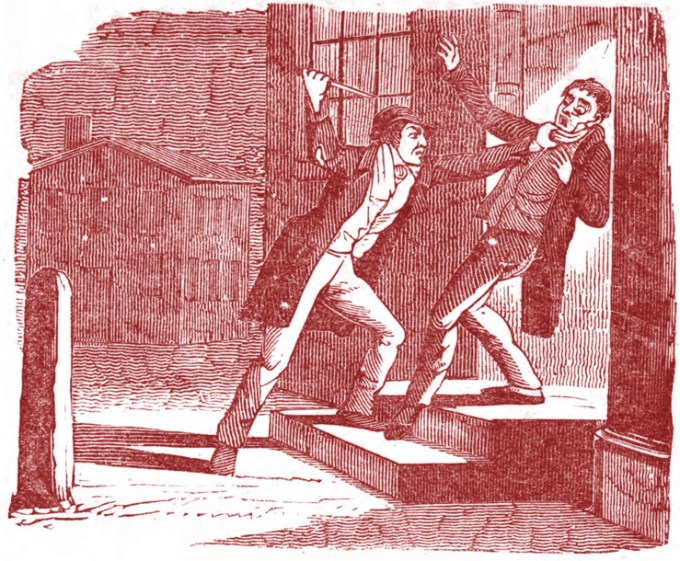
On April 7, 1840 – as loafers often do – he was drinking with cronies in the brothel of Judy Young in Nashville when Moses Parks stormed into the place. Earlier, he’d had a fight with Parks and witnesses edged towards the exits as the two faced off. Parks accused Claxton of ripping his shirt earlier, then reached out and tore the ruffle off the front of Claxton’s own shirt, saying, “Now we are even!”
A “hurt and afraid” Claxton responded “[Expletive] Yes we are!” before pulling a clasp knife from his pocket with a blade “about the length of his finger,” and stabbed Parks in the chest. Parks died very shortly thereafter while Claxton made a hasty getaway. He was soon apprehended and taken to jail, charged with murder.
Tried on May 12, 1840, he was found guilty of the lesser charge of manslaughter, and sentenced to 5 years at hard labor in the State Penitentiary. He appealed to the Supreme Court of the state and was granted a hearing. Four days before Christmas they rendered their verdict: Even though the Judge made questionable remarks to the jury during his instructions, the high court ruled he had not actually committed an error. The verdict stood, and the same day Jim Claxton entered the prison on Church Street to start his five year sentence.
He didn’t make it. Like many another, he fell victim to the horrifying conditions within the hell hole that was “Old Red Top.” On March 18, 1844 he died of “marasmus,” or acute malnutrition. To put it another way, just three years into his sentence, the once robust young man had died of starvation.
In a sense, James Claxton and Moses Parks were both tragic nobodies, living and dying in the shadows of Jacksonian Nashville. But the their case serves as a peek into their squalid world, and allows us a more thorough view of the “have nots” as well as the “haves” of the city on the Cumberland in the 1840’s.
It’s also a lesson that not everything is out there on the net…sometimes ya just gotta dig.
 nashvillemayhemdotcom